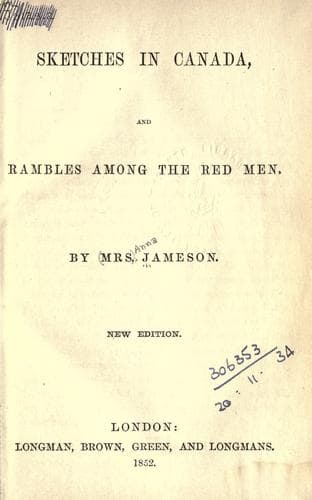
Sketches in Canada, and rambles among the red menJameson, Mrs. (Anna)
History
Sketches in Canada, and rambles among the red men
Jameson, Mrs. (Anna)
Indians of North America -- Canada; Ontario -- Description and travel
A cousin of mine (I have now a large Chippewa cousinship) went on a
hunting excursion, leaving his wife and child in his lodge. During his
absence, a party of Sioux carried them off, and on his return he found
his fire extinguished, and his lodge empty. He immediately blackened his
face (Indian mourning), and repaired to the lodge of his wife's brother,
to whom he sang, in a kind of mournful recitative, the following song;
the purport of which seems to be partly a request for aid against his
enemies, and partly an excuse for the seeming fault of leaving his
family unprotected in his wigwam.
My brother-in-law, do not wrongfully accuse me for this seeming
neglect in exposing my family, for I have come to request aid
from my brother-in-law!
The cry of my little son was heard as they carried him across
the prairie, and therefore I have come to supplicate aid from my
brother-in-law.
And the voice also of my wife was heard as they carried her
across the prairie; do not then accuse your brother-in-law, for
he has come to seek aid from his brother-in-law!
This song is, in measure, ten and eight syllables alternately; and the
perpetual recurrence of the word brother-in-law seems intended to
impress the idea of their relationship on the mind of the hearer.
The next is the address of a war party to their women, on leaving the
village.[44]
Do not weep, do not weep for me,
Loved women, should I die;
For yourselves alone should you weep!
Poor are ye all and to be pitied:
Ye women, ye are to be pitied!
I seek, I seek our fallen relations,
I go to revenge, revenge the slain,
Our relations fallen and slain,
And our foes, our foes shall lie
Like them, like them shall they lie,
I go to lay them low, to lay them low!
And then _da capo_, over and over again.
The next is a love song, in the same style of iteration.
'Tis now two days, two long days,
Since last I tasted food;
'Tis for you, for you, my love,
That I grieve, that I grieve,
'Tis for you, for you that I grieve!
The waters flow deep and wide,
On which, love, you have sailed;
Dividing you far from me.
'Tis for you, for you, my love,
'Tis for you, for you that I grieve!
If you look at some half thousand of our most fashionable and admired
Italian songs--the Notturni of Blangini, for instance--you will find
them very like this Chippewa canzonetta, in the no meaning and perpetual
repetition of certain words and phrases; at the same time, I doubt if it
be _always_ necessary for a song to have a meaning--it is enough if it
have a sentiment.
Here are some verses of a war song, in the same style as to composition,
but breathing very different sentiments.
I sing, I sing, under the centre of the sky,
Under the centre of the sky
Under the centre of the sky I sing, I sing,
Under the centre of the sky!
Public-domain text, read in full here on John Shaqi.
Reviews
Reviews
No reviews yet
Be the first to share your thoughts on this work.
Elsewhere in the archive
Join the Discussion
Join the discussion
Sign in to leave a comment or review.
Sign InorCreate an account