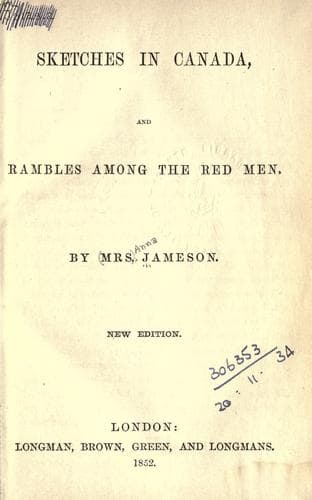
Sketches in Canada, and rambles among the red menJameson, Mrs. (Anna)
History
Sketches in Canada, and rambles among the red men
Jameson, Mrs. (Anna)
Indians of North America -- Canada; Ontario -- Description and travel
The mortality among the children is great among the unreclaimed Indians,
from want of knowing how to treat infantine maladies, and from want of
cleanliness. When dysentery is brought on from this cause, the children
almost invariably perish. When kept clean, the bark-cradles are
excellent things for their mode of life, and effectually preserve the
head and limbs of the infant from external injury.
When a young Chippewa of St. Mary's sees a young girl who pleases him,
and whom he wishes to marry, he goes and catches a loach, boils it, and
cuts off the tail, of which he takes the flat bone, and sticks it in his
hair. He paints himself bewitchingly, takes a sort of rude flute or
pipe, with two or three stops, which seems to be only used on these
amatory occasions, and walks up and down his village, blowing on his
flute, and looking, I presume, as sentimental as an Indian _can_ look.
This is regarded as an indication of his intentions, and throws all the
lodges in which there are young marriageable girls into a flutter,
though probably the fair one who is his secret choice is pretty well
aware of it. The next step is to make presents to the parents and
relatives of the young woman; if these are accepted, and his suit
prospers, he makes presents to his intended; and all that now remains is
to bring her home to his lodge. He neither swears before God to love her
till death--an oath which it depends not on his own will to keep, even
if it be not perjury in the moment it is pronounced--nor to endow her
with _all_ his worldly goods and chattels, when even by the act of union
she loses all right of property; but apparently the arrangements answer
all purposes, to their mutual satisfaction.
The names of the women are almost always derived from some objects or
appearances in nature, generally of a pleasing kind; the usual
termination _qua_ or _quay_, immediately blending with their
signification the idea of womanhood. Thus, my Indian mother is "the
green prairie," (woman). Mrs. Schoolcraft's name,
Obah,bahm,wa,wa,ge,zhe,go,quà, signifies literally the "sound which the
stars make rushing through the sky," and which I translate into _the
music of the spheres_. Mrs. MacMurray is "the wild rose:" one of her
youngest sisters is Wah,bu,nung,o,quà, the morning star (woman): another
is Omis,ka,bu,go,quà, (the woman of) "the red leaf."
* * * * *
I went to-day to take leave of my uncle Wayish,ky, and found him
ill--poor fellow! he is fretting about his younger son. I learn with
pleasure that his daughter Zah,gah,see,ga,quà is likely to accompany me
to the Manitoolin Islands.
* * * * *
July 31.
Public-domain text, read in full here on John Shaqi.
Reviews
Reviews
No reviews yet
Be the first to share your thoughts on this work.
Elsewhere in the archive
Join the Discussion
Join the discussion
Sign in to leave a comment or review.
Sign InorCreate an account