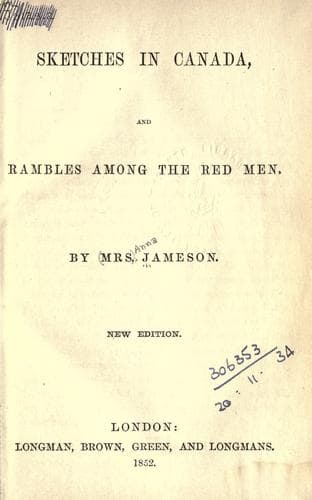
Sketches in Canada, and rambles among the red menJameson, Mrs. (Anna)
History
Sketches in Canada, and rambles among the red men
Jameson, Mrs. (Anna)
Indians of North America -- Canada; Ontario -- Description and travel
He has sixteen acres of orchard-ground, in which he has planted and
reared with success all the common European fruits, as apples, pears,
plums, cherries, in abundance; but what delighted me beyond everything
else, was a garden of more than two acres, very neatly laid out and
enclosed, and in which he evidently took exceeding pride and pleasure;
it was the first thing he showed me after my arrival. It abounds in
roses of different kinds, the cuttings of which he had brought himself
from England in the few visits he had made there. Of these he gathered
the most beautiful buds, and presented them to me with such an air as
might have become Dick Talbot presenting a bouquet to Miss Jennings.[14]
We then sat down on a pretty seat under a tree, where he told me he
often came to meditate. He described the appearance of the spot when he
first came here as contrasted with its present appearance, or we
discussed the exploits of some of his celebrated and gallant ancestors,
with whom my acquaintance was (luckily) almost as intimate as his own.
Family and aristocratic pride I found a prominent feature in the
character of this remarkable man. A Talbot of Malahide, of a family
representing the same barony from father to son for six hundred years,
he set, not unreasonably, a high value on his noble and unstained
lineage; and, in his lonely position, the simplicity of his life and
manners lent to these lofty and not unreal pretensions a kind of
poetical dignity.
I told him of the surmises of the people relative to his early life and
his motives for emigrating, at which he laughed.
"Charlevoix," said he, "was, I believe, the true cause of my coming to
this place. You know he calls this the 'Paradise of the Hurons.' Now I
was resolved to get to paradise by hook or by crook, and so I came
here."
He added, more seriously, "I have accomplished what I resolved to do--it
is done; but I would not, if any one was to offer me the universe, go
through again the _horrors_ I have undergone in forming this
settlement. But do not imagine I repent it; I like my retirement."
He then broke out against the follies, and falsehoods, and restrictions
of artificial life, in bitter and scornful terms; no ascetic monk or
_radical_ philosopher could have been more eloquently indignant.
I said it was granted to few to live a life of such complete retirement,
and at the same time such general utility; in flying from the world, he
had benefited it: and I added, that I was glad to see him so happy.
"Why, yes, I'm very happy here." And then the old man sighed.
I understood that sigh, and in my heart echoed it. No, "it is not good
for man to be alone;" and this law, which the Father of all life
pronounced himself at man's creation, was never yet violated with
impunity. Never yet was the human being withdrawn from, or elevated
above, the social wants and sympathies of his human nature, without
paying a tremendous price for such isolated independence.
Public-domain text, read in full here on John Shaqi.
Reviews
Reviews
No reviews yet
Be the first to share your thoughts on this work.
Elsewhere in the archive
Join the Discussion
Join the discussion
Sign in to leave a comment or review.
Sign InorCreate an account