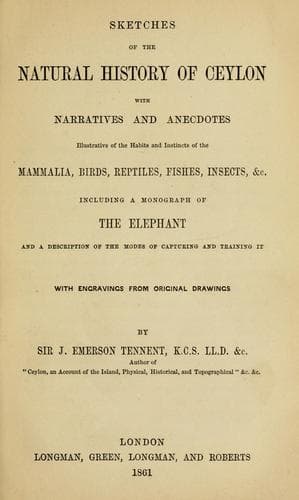
Sketches of the Natural History of CeylonTennent, James Emerson, Sir
Science
Sketches of the Natural History of Ceylon
Tennent, James Emerson, Sir
Animals -- Sri Lanka; Asiatic elephant -- Sri Lanka
One gentleman in Ceylon, not less distinguished for his genuine kindness
of heart, than for his marvellous success in shooting elephants, avowed
to me that the eagerness with which he found himself impelled to pursue
them had often excited surprise in his own mind; and although he had
never read the theory of Lord Kames, or the speculations of Vicesimus
Knox, he had come to the conclusion that the passion thus excited within
him was a remnant of the hunter's instinct, with which man was
originally endowed, to enable him, by the chase, to support existence in
a state of nature, and which, though rendered dormant by civilisation,
had not been utterly eradicated.
This theory is at least more consistent and intelligible than the "love
of nature and scenery," sentimentally propounded by the author quoted
above.]
But notwithstanding this prodigious destruction, a reward of a few
shillings per head offered by the Government for taking elephants was
claimed for 3500 destroyed in part of the northern province alone, in
less than three years prior to 1848: and between 1851 and 1856, a
similar reward was paid for 2000 in the southern province, between Galle
and Hambangtotte.
Although there is little opportunity for the display of marksmanship in
an elephant battue, there is one feature in the sport, as conducted in
Ceylon, which contrasts favourably with the slaughterhouse details
chronicled with revolting minuteness in some recent accounts of elephant
shooting in South Africa. The practice in Ceylon is to aim invariably at
the head, and the sportsman finds his safety to consist in boldly facing
the animal, advancing to within fifteen paces, and lodging a bullet,
either in the temple or in the hollow over the eye, or in a well-known
spot immediately above the trunk, where the weaker structure of the
skull affords an easy access to the brain.[1] The region of the ear is
also a fatal spot, and often resorted to,--the places I have mentioned
in the front of the head being only accessible when the animal is
"charging." Professor HARRISON, in his communication to the Royal Irish
Academy on the Anatomy of the Elephant, has rendered an intelligible
explanation of this in the following passage descriptive of the
cranium:--"it exhibits two remarkable facts: _first_, the small space
occupied by the brain; and, _secondly_, the beautiful and curious
structure of the bones of the head. The two tables of all these bones,
except the occipital, are separated by rows of large cells, some from
four to five inches in length, others only small, irregular, and
honey-comb-like:--these all communicate with each other, and, through
the frontal sinuses, with the cavity of the nose, and also with the
tympanum or drum of each ear; consequently, as in some birds, these
cells are filled with air, and thus while the skull attains a great size
in order to afford an extensive surface for the attachment of muscles,
and a mechanical support for the tusks, it is at the same time very
Public-domain text, read in full here on John Shaqi.
Reviews
Reviews
No reviews yet
Be the first to share your thoughts on this work.
Elsewhere in the archive
Join the Discussion
Join the discussion
Sign in to leave a comment or review.
Sign InorCreate an account