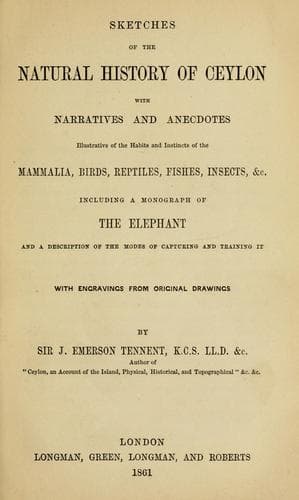
Sketches of the Natural History of CeylonTennent, James Emerson, Sir
Science
Sketches of the Natural History of Ceylon
Tennent, James Emerson, Sir
Animals -- Sri Lanka; Asiatic elephant -- Sri Lanka
The _keddah_ being prepared, the first operation is to drive the
elephants towards it, for which purpose vast bodies of men fetch a
compass in the forest around the haunts of the herds, contracting it by
degrees, till they complete the enclosure of a certain area, round which
they kindle fires, and cut footpaths through the jungle, to enable the
watchers to communicate and combine. All this is performed in cautious
silence and by slow approaches, to avoid alarming the herd. A fresh
circle nearer to the _keddah_ is then formed in the same way, and into
this the elephants are admitted from the first one, the hunters
following from behind, and lighting new fires around the newly inclosed
space. Day after day the process is repeated; till the drove having been
brought sufficiently close to make the final rush, the whole party close
in from all sides, and with drums, guns, shouts, and flambeaux, force
the terrified animals to enter the fatal enclosure, when the passage is
barred behind them, and retreat rendered impossible.
Their efforts to escape are repressed by the crowd, who drive them back
from the stockade with spears and flaming torches; and at last compel
them to pass on into the second enclosure. Here they are detained for a
short time, and their feverish exhaustion relieved by free access to
water;--until at last, being tempted by food, or otherwise induced to
trust themselves in the narrow outlet, they are one after another made
fast by ropes, passed in through the palisade; and picketed in the
adjoining woods to enter on their course of systematic training.
These arrangements vary in different districts of Bengal; and the method
adopted in Ceylon differs in many essential particulars from them all;
the Keddah, or, as it is here called, the corral or _korahl_[1] (from
the Portuguese _curral_, a "cattle-pen"), consists of but one enclosure
instead of three. A stream or watering-place is not uniformly enclosed
within it, because, although water is indispensable after the long
thirst and exhaustion of the captives, it has been found that a pond or
rivulet within the corral itself adds to the difficulty of leading them
out, and increases their reluctance to leave it; besides which, the
smaller ones are often smothered by the others in their eagerness to
crowd into the water. The funnel-shaped outlet is also dispensed with,
as the animals are liable to bruise and injure themselves within the
narrow stockade; and should one of them die in it, as is too often the
case in the midst of the struggle, the difficulty of removing so great a
carcase is extreme. The noosing and securing them, therefore, takes
place in Ceylon within the area of the first enclosure into which they
enter, and the dexterity and daring displayed in this portion of the
work far surpasses that of merely attaching the rope through the
openings of the paling, as in an Indian keddah.
Public-domain text, read in full here on John Shaqi.
Reviews
Reviews
No reviews yet
Be the first to share your thoughts on this work.
Elsewhere in the archive
Join the Discussion
Join the discussion
Sign in to leave a comment or review.
Sign InorCreate an account