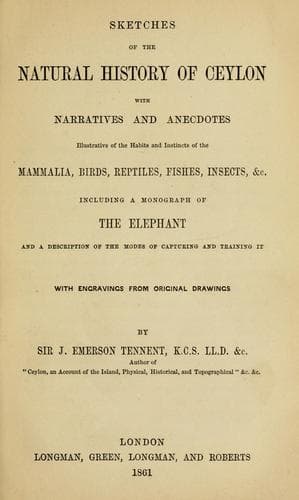
Sketches of the Natural History of CeylonTennent, James Emerson, Sir
Science
Sketches of the Natural History of Ceylon
Tennent, James Emerson, Sir
Animals -- Sri Lanka; Asiatic elephant -- Sri Lanka
Our cavalcade was as oriental as the scenery through which it moved; the
Governor and the officers of his staff and household formed a long
cortege, escorted by the native attendants, horse-keepers, and
foot-runners. The ladies were borne in palankins, and the younger
individuals of the party carried in chairs raised on poles, and covered
with cool green awnings made of the fresh leaves of the talipat palm.
After traversing the cultivated lands, the path led across open glades
of park-like verdure and beauty, and at last entered the great-forest
under the shade of ancient trees wreathed to their crowns with climbing
plants and festooned by natural garlands of convolvulus and orchids.
Here silence reigned, disturbed only by the murmuring hum of glittering
insects, or the shrill clamour of the plum-headed parroquet and the
flute-like calls of the golden oriole.
We crossed the broad sandy beds of two rivers over-arched by tall trees,
the most conspicuous of which is the Kombook[1], from the calcined bark
of which the natives extract a species of lime to be used with their
betel. And from the branches hung suspended over the water the gigantic
pods of the huge puswæl bean[2], the sheath of which measures six feet
long by five or six inches broad.
[Footnote 1: _Pentaptera paniculata_.]
[Footnote 2: _Entada pursætha_.]
On ascending the steep bank of the second stream, we found ourselves in
front of the residences which had been extemporised for our party in the
immediate vicinity of the corral. These cool and enjoyable structures
were formed of branches and thatched with palm leaves and fragrant lemon
grass; and in addition to a dining-room and suites of bedrooms fitted
with tent furniture, they included kitchens, stables, and storerooms,
all run up by the natives in the course of a few days.
In former times, the work connected with these elephant hunts was
performed by the "forced labour" of the natives, as part of that feudal
service which under the name of Raja-kariya was extorted from the
Singhalese during the rule of their native sovereigns. This system was
continued by the Portuguese and Dutch, and prevailed under the British
Government till its abolition by the Earl of Ripon in 1832. Under it
from fifteen hundred to two thousand men superintended by their headmen,
used to be occupied, in constructing the corral, collecting the
elephants, maintaining the cordon of watch-fires and watchers, and
conducting all the laborious operations of the capture. Since the
abolition of Raja-kariya, however, no difficulty has been found in
obtaining the voluntary co-operation of the natives on these exciting
occasions. The government defrays the expense of that portion of the
preparations which involves actual cost,--for the skilled labour
expended in the erection of the corral and its appurtenances, and the
providing of spears, ropes, arms, flutes, drums, gunpowder, and other
necessaries for the occasion.
Public-domain text, read in full here on John Shaqi.
Reviews
Reviews
No reviews yet
Be the first to share your thoughts on this work.
Elsewhere in the archive
Join the Discussion
Join the discussion
Sign in to leave a comment or review.
Sign InorCreate an account