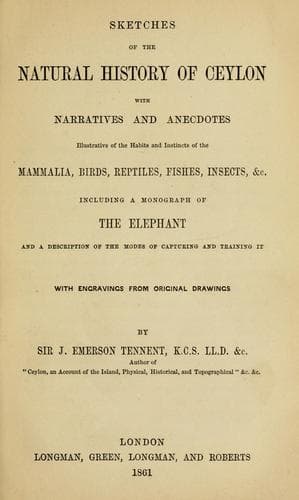
Sketches of the Natural History of CeylonTennent, James Emerson, Sir
Science
Sketches of the Natural History of Ceylon
Tennent, James Emerson, Sir
Animals -- Sri Lanka; Asiatic elephant -- Sri Lanka
At length, the bars which secured the entrance to the corral were
cautiously withdrawn, and two trained elephants passed stealthily in,
each ridden by its mahout (or _ponnekella_, as the keeper is termed in
Ceylon), and one attendant; and, carrying a strong collar, formed by
coils of rope made from coco-nut fibre, from which hung on either side
cords of elk's hide, prepared with a ready noose. Along with these, and
concealed behind them, the headman of the "_cooroowe_," or noosers,
crept in, eager to secure the honour of taking the first elephant, a
distinction which this class jealously contests with the mahouts of the
chiefs and temples. He was a wiry little man, nearly seventy years old,
who had served in the same capacity under the Kandyan king, and wore two
silver bangles, which had been conferred on him in testimony of his
prowess. He was accompanied by his son, named Ranghanie, equally
renowned for his courage and dexterity.
On this occasion ten tame elephants were in attendance; two were the
property of an adjoining temple (one of which had been caught but the
year before, yet it was now ready to assist in capturing others), four
belonged to the neighbouring chiefs, and the rest, including the two
which first entered the corral, were part of the Government stud. Of the
latter, one was of prodigious age, having been in the service of the
Dutch and English Governments in succession for upwards of a century.[1]
The other, called by her keeper "Siribeddi," was about fifty years old,
and distinguished for gentleness and docility. She was a most
accomplished decoy, and evinced the utmost relish for the sport. Having
entered the corral noiselessly, carrying a mahout on her shoulders with
the headman of the noosers seated behind him, she moved slowly along
with a sly composure and an assumed air of easy indifference; sauntering
leisurely in the direction of the captives, and halting now and then to
pluck a bunch of grass or a few leaves as she passed. As she approached
the herd, they put themselves in motion to meet her, and the leader,
having advanced in front and passed his trunk gently over her head,
turned and paced slowly back to his dejected companions. Siribeddi
followed with the same listless step, and drew herself up close behind
him, thus affording the nooser an opportunity to stoop under her and
slip the noose over the hind foot of the wild one. The latter instantly
perceived his danger, shook off the rope, and turned to attack the man.
He would have suffered for his temerity had not Siribeddi protected him
by raising her trunk and driving the assailant into the midst of the
herd, when the old man, being slightly wounded, was helped out of the
corral, and his son, Ranghanie, took his place.
[Footnote 1: This elephant is since dead; she grew infirm and diseased,
and died at Colombo in 1848. Her skeleton is now in the Museum of the
Natural History Society at Belfast.]
Public-domain text, read in full here on John Shaqi.
Reviews
Reviews
No reviews yet
Be the first to share your thoughts on this work.
Elsewhere in the archive
Join the Discussion
Join the discussion
Sign in to leave a comment or review.
Sign InorCreate an account