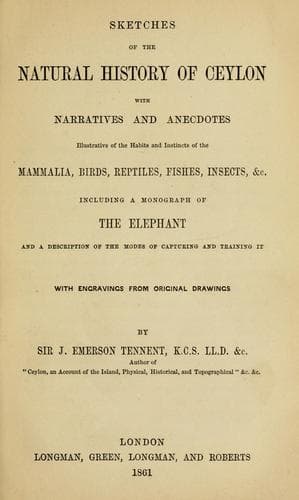
Sketches of the Natural History of CeylonTennent, James Emerson, Sir
Science
Sketches of the Natural History of Ceylon
Tennent, James Emerson, Sir
Animals -- Sri Lanka; Asiatic elephant -- Sri Lanka
Of the two young elephants which were taken in the corral, the smallest
was sent down to my house at Colombo, where he became a general
favourite with the servants. He attached himself especially to the
coachman, who had a little shed erected for him near his own quarters at
the stables. But his favourite resort was the kitchen, where he received
a daily allowance of milk and plantains, and picked up several other
delicacies besides. He was innocent and playful in the extreme, and when
walking in the grounds he would trot up to me, twine his little trunk
round my arm, and coax me to take him to the fruit-trees. In the evening
the grass-cutters now and then indulged him by permitting him to carry
home a load of fodder for the horses, on which occasions he assumed an
air of gravity that was highly amusing, showing that he was deeply
impressed with the importance and responsibility of the service
entrusted to him. Being sometimes permitted to enter the dining-room,
and helped to fruit at desert, he at last learned his way to the
side-board; and on more than one occasion having stolen in, during the
absence of the servants, he made a clear sweep of the wine-glasses and
china in his endeavours to reach a basket of oranges. For these and
similar pranks we were at last forced to put him away. He was sent to
the Government stud, where he was affectionately received and adopted by
Siribeddi, and he now takes his turn of public duty in the department of
the Commissioner of Roads.
CHAP. VII.
THE ELEPHANT.
* * * * *
_Conduct in Captivity._
The idea prevailed in ancient times, and obtains even at the present
day, that the Indian elephant surpasses that of Africa in sagacity and
tractability, and consequently in capacity for training, so as to render
its services more available to man. There does not appear to me to be
sufficient ground for this conclusion. It originated, in all
probability, in the first impressions created by the accounts of the
elephant brought back by the Greeks after the Indian expedition of
Alexander, and above all by the descriptions of Aristotle, whose
knowledge of the animal was derived exclusively from the East. A long
interval elapsed before the elephant of Africa, and its capabilities,
became known in Europe. The first elephants brought to Greece by
Antipater, were from India, as were also those introduced by Pyrrhus
into Italy. Taught by this example, the Carthaginians undertook to
employ African elephants in war. Jugurtha led them against Metellus, and
Juba against Cæsar; but from inexperienced and deficient training, they
proved less effective than the elephants of India[1], and the historians
of these times ascribed to inferiority of race, that which was but the
result of insufficient education.
Public-domain text, read in full here on John Shaqi.
Reviews
Reviews
No reviews yet
Be the first to share your thoughts on this work.
Elsewhere in the archive
Join the Discussion
Join the discussion
Sign in to leave a comment or review.
Sign InorCreate an account