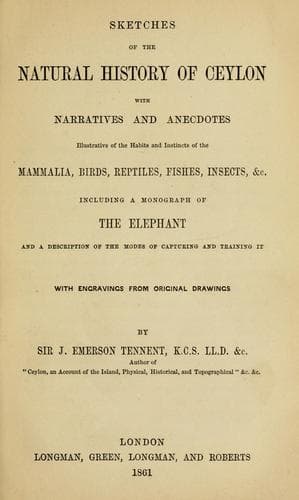
Sketches of the Natural History of CeylonTennent, James Emerson, Sir
Science
Sketches of the Natural History of Ceylon
Tennent, James Emerson, Sir
Animals -- Sri Lanka; Asiatic elephant -- Sri Lanka
The first employment to which an elephant is put is to tread clay in a
brick-field, or to draw a waggon in double harness with a tame
companion. But the work in which the display of sagacity renders his
labours of the highest value, is that which involves the use of heavy
materials; and hence in dragging and piling timber, or moving stones[1]
for the construction of retaining walls and the approaches to bridges,
his services in an unopened country are of the utmost importance. When
roads are to be constructed along the face of steep declivities, and the
space is so contracted that risk is incurred either of the working
elephant falling over the precipice or of rocks slipping down from
above, not only are the measures to which he resorts the most judicious
and reasonable that could be devised, but if urged by his keeper to
adopt any other, he manifests a reluctance sufficient to show that he
has balanced in his own mind the comparative advantages of each. An
elephant appears on all occasions to comprehend the purpose and object
that he is expected to promote, and hence he voluntarily executes a
variety of details without any guidance whatever from his keeper. This
is one characteristic in which this animal manifests a superiority over
the horse; although his strength in proportion to his weight is not so
great as that of the latter.
[Footnote 1: A correspondent informs me that on the Malabar coast of
India, the elephant, when employed in dragging stones, moves them by
means of a rope, which he either draws with his forehead, or manages by
seizing it in his teeth.]
His minute motions when engrossed by such operations, the activity of
his eye, and the earnestness of his attitudes, can only be comprehended
by being seen. In moving timber and masses of rock his trunk is the
instrument on which he mainly relies, but those which have tusks turn
them to good account. To get a weighty stone out of a hollow an elephant
will kneel down so as to apply the pressure of his head to move it
upwards, then steadying it with one foot till he can raise himself, he
will apply a fold of his trunk to shift it to its place, and fit it
accurately in position: this done, he will step round to view it on
either side, and adjust it with due precision. He appears to gauge his
task by his eye, and to form a judgment whether the weight be
proportionate to his strength. If doubtful of his own power, he
hesitates and halts, and if urged against his will, he roars and shows
temper.
In clearing an opening through forest land, the power of the African
elephant, and the strength ascribed to him by a recent traveller, as
displayed in uprooting trees, have never been equalled or approached by
anything I have seen of the elephant in Ceylon[1] or heard of them in
India.
Public-domain text, read in full here on John Shaqi.
Reviews
Reviews
No reviews yet
Be the first to share your thoughts on this work.
Elsewhere in the archive
Join the Discussion
Join the discussion
Sign in to leave a comment or review.
Sign InorCreate an account