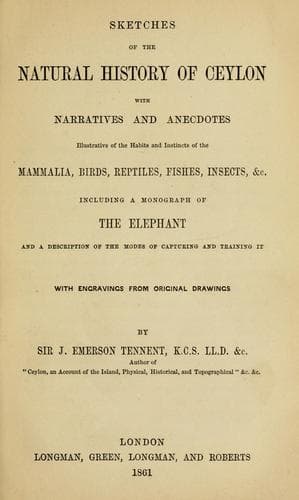
Sketches of the Natural History of CeylonTennent, James Emerson, Sir
Science
Sketches of the Natural History of Ceylon
Tennent, James Emerson, Sir
Animals -- Sri Lanka; Asiatic elephant -- Sri Lanka
A tree of twelve inches in diameter resisted successfully the most
strenuous struggles of the largest elephant I ever saw led to it; and
when directed by their keepers to clear away jungle, the removal of even
a small tree, or a healthy young coco-nut palm, is a matter both of time
and exertion. Hence the services of an elephant are of much less value
in clearing a forest than in dragging and piling felled timber. But in
the latter occupation he manifests an intelligence and dexterity which
is surprising to a stranger, because the sameness of the operation
enables the animal to go on for hours disposing of log after log, almost
without a hint or direction from his attendant. For example, two
elephants employed in piling ebony and satinwood in the yards attached
to the commissariat stores at Colombo, were so accustomed to their work,
that they were able to accomplish it with equal precision and with
greater rapidity than if it had been done by dock-labourers. When the
pile attained a certain height, and they were no longer able by their
conjoint efforts to raise one of the heavy logs of ebony to the summit,
they had been taught to lean two pieces against the heap, up the
inclined plane of which they gently rolled the remaining logs, and
placed them trimly on the top.
It has been asserted that in their occupations "elephants are to a
surprising extent the creatures of habit,"[1] that their movements are
altogether mechanical, and that "they are annoyed by any deviation from
their accustomed practice, and resent any constrained departure from the
regularity of their course." So far as my own observation goes, this is
incorrect; and I am assured by officers of experience, that in regard to
changing his treatment, his hours, or his occupation, an elephant
evinces no more consideration than a horse, but exhibits the same
pliancy and facility.
[Footnote 1: _Menageries_, &c., "The Elephant," vol. ii. p. 23.]
At one point, however, the utility of the elephant stops short. Such is
the intelligence and earnestness he displays in work, which he seems to
conduct almost without supervision, that it has been assumed[1] that he
would continue his labour, and accomplish his given task, as well in the
absence of his keeper as during his presence. But here his innate love
of ease displays itself, and if the eye of his attendant be withdrawn,
the moment he has finished the thing immediately in hand, he will stroll
away lazily, to browse or enjoy the luxury of fanning himself and
blowing dust over his back.
[Footnote 1: _Ibid._, ch. vi. p. 138.]
Public-domain text, read in full here on John Shaqi.
Reviews
Reviews
No reviews yet
Be the first to share your thoughts on this work.
Elsewhere in the archive
Join the Discussion
Join the discussion
Sign in to leave a comment or review.
Sign InorCreate an account