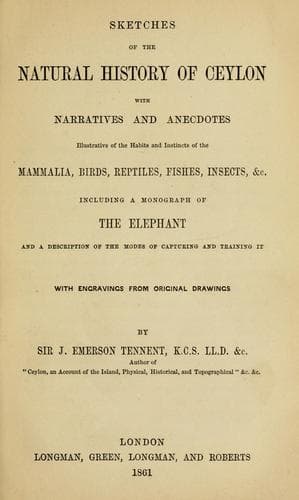
Sketches of the Natural History of CeylonTennent, James Emerson, Sir
Science
Sketches of the Natural History of Ceylon
Tennent, James Emerson, Sir
Animals -- Sri Lanka; Asiatic elephant -- Sri Lanka
I. ACCIPITRES. _Eagles_.--The Eagles, however, are small, and as
compared with other countries rare; except, perhaps, the crested
eagle[1], which haunts the mountain provinces and the lower hills,
disquieting the peasantry by its ravages amongst their poultry; and the
gloomy serpent eagle[2], which, descending from its eyrie in the lofty
jungle, and uttering a loud and plaintive cry, sweeps cautiously around
the lonely tanks and marshes, to feed upon the reptiles on their margin.
The largest eagle is the great sea Erne[3], seen on the northern coasts
and the salt lakes of the eastern provinces, particularly when the
receding tide leaves bare an expanse of beach, over which it hunts, in
company with the fishing eagle[4], sacred to Siva. Unlike its
companions, however, the sea eagle rejects garbage for living prey, and
especially for the sea snakes which abound on the northern coasts. These
it seizes by descending with its wings half closed, and, suddenly
darting down its talons, it soars aloft again with its writhing
victim.[5]
[Footnote 1: Spizaëtuslimnaëtus, _Horsf_. The race of these birds in the
Deccan and Ceylon are rather more crested, originating the Sp.
Cristatellus, _Auct_.]
[Footnote 2: Which Gould believes to be the _Hæmatornis Bacha_, Daud.]
[Footnote 3: Pontoaëtus leucogaster, _Gmel_.]
[Footnote 4: Haliastur Indus, _Bodd._]
[Footnote 5: E.L. Layard. Europeans have given this bird the name of the
"Brahminy Kite," probably from observing the superstitious feeling of
the natives regarding it, who believe that when two armies are about to
engage, its appearance prognosticates victory to the party over whom it
hovers.]
_Hawks_.--The beautiful Peregrine Falcon[1] is rare, but the Kestrel[2]
is found almost universally; and the bold and daring Goshawk[3] wherever
wild crags and precipices afford safe breeding places. In the district
of Anarajapoora, where it is trained for hawking, it is usual, in lieu
of a hood, to darken its eyes by means of a silken thread passed through
holes in the eyelids. The ignoble birds of prey, the Kites[4], keep
close by the shore, and hover round the returning boats of the fishermen
to feast on the fry rejected from their nets.
[Footnote 1: Falco peregrinus, _Linn._]
[Footnote 2: Tinnunculus alaudarius, _Briss._]
[Footnote 3: Astur trivirgatus, _Temm._]
[Footnote 4: Milvus govinda, _Sykes._ Dr. Hamilton Buchanan remarks that
when gorged this bird delights to sit on the entablature of buildings,
exposing its back to the hottest rays of the sun, placing its breast
against the wall, and stretching out its wings _exactly as the Egyptian
Hawk is represented on the monuments_.]
Public-domain text, read in full here on John Shaqi.
Reviews
Reviews
No reviews yet
Be the first to share your thoughts on this work.
Elsewhere in the archive
Join the Discussion
Join the discussion
Sign in to leave a comment or review.
Sign InorCreate an account