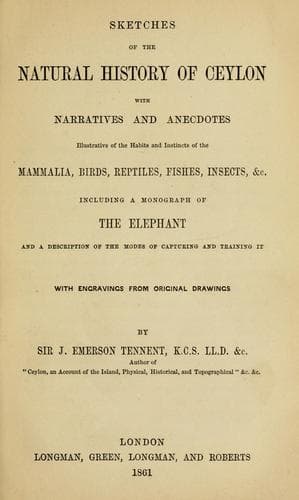
Sketches of the Natural History of CeylonTennent, James Emerson, Sir
Science
Sketches of the Natural History of Ceylon
Tennent, James Emerson, Sir
Animals -- Sri Lanka; Asiatic elephant -- Sri Lanka
In a lonely spot, towards the very centre of the tank, we came
unexpectedly upon an extraordinary scene. A sheet of still water, two or
three hundred yards broad, and about half a mile long, was surrounded by
a line of tall forest-trees, whose branches stretched above its margin.
The sun had not yet risen, when we perceived some white objects in large
numbers on the tops of the trees; and as we came nearer, we discovered
that a vast colony of pelicans had formed their settlement and
breeding-place in this solitary retreat. They literally covered the
trees in hundreds; and their heavy nests, like those of the swan,
constructed of large sticks, forming great platforms, were sustained by
the horizontal branches. Each nest contained three eggs, rather larger
than those of a goose; and the male bird stood placidly beside the
female as she sat upon them.
Nor was this all; along with the pelicans prodigious numbers of other
water-birds had selected this for their dwelling-place, and covered the
trees in thousands, standing on the topmost branches; tall flamingoes,
herons, egrets, storks, ibises, and other waders. We had disturbed them
thus early, before their habitual hour for betaking themselves to their
fishing-fields. By degrees, as the light increased, we saw them
beginning to move upon the trees; they looked around them on every side,
stretched their awkward legs behind them, extended their broad wings,
gradually rose in groups, and slowly soared away in the direction of the
seashore.
The pelicans were apparently later in their movements; they allowed us
to approach as near them as the swampy nature of the soil would permit;
and even when a gun was discharged amongst them, only those moved off
which the particles of shot disturbed. They were in such numbers at this
favourite place; that the water over which they had taken up their
residence was swarming with crocodiles, attracted by the frequent fall
of the young birds; and the natives refused, from fear of them, to wade
in for one of the larger pelicans which had fallen, struck by a rifle
ball. It was altogether a very remarkable sight.
Of the birds familiar to European sportsmen, partridges and quails are
to be had at all times; the woodcock has occasionally been shot in the
hills, and the ubiquitous snipe, which arrives in September from
Southern India, is identified not alone by the eccentricity of its
flight, but by retaining in high perfection the qualities which have
endeared it to the gastronome at home. But the magnificent pheasants,
which inhabit the Himalayan range and the woody hills of the Chin-Indian
peninsula, have no representative amongst the tribes that people the
woods of Ceylon; although a bird believed to be a pheasant has more than
once been seen in the jungle, close to Rangbodde, on the road to
Neuera-ellia.
* * * * *
_List of Ceylon Birds_.
Public-domain text, read in full here on John Shaqi.
Reviews
Reviews
No reviews yet
Be the first to share your thoughts on this work.
Elsewhere in the archive
Join the Discussion
Join the discussion
Sign in to leave a comment or review.
Sign InorCreate an account