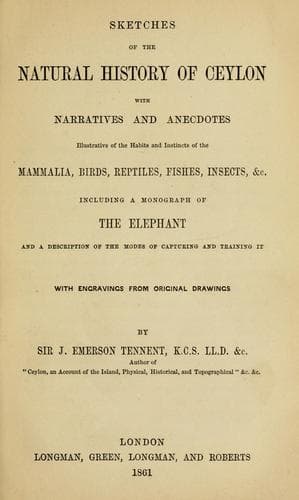
Sketches of the Natural History of CeylonTennent, James Emerson, Sir
Science
Sketches of the Natural History of Ceylon
Tennent, James Emerson, Sir
Animals -- Sri Lanka; Asiatic elephant -- Sri Lanka
[Footnote 1: A native gentleman who resided for a long time at Caltura
tells me that in the rivers which flow into the sea, both there and at
Bentotte, crocodiles are frequently caught in corrals, formed of stakes
driven into the ground in shallow water, and so constructed, that when
the reptile enters to seize the bait placed within, the aperture closes
behind and secures him. A professional "crocodile charmer" then enters
muttering a spell, and with one end of a stick pats the creature gently
on the head for a time. The operator then boldly mounts astride upon its
shoulders, and continues to soothe it with his one hand, whilst with the
other he contrives to pass a rope under its body, by which it is at last
dragged on shore. This story serves to corroborate the narrative of Mr.
Waterton and his alligator.]
The Singhalese believe that the crocodile can only move swiftly on sand
or smooth clay, its feet being too tender to tread firmly on hard or
stony ground. In the dry season, when the watercourses begin to fail and
the tanks become exhausted, the marsh-crocodiles have occasionally been
encountered in the jungle, wandering in search of water. During a severe
drought in 1844, they deserted a tank near Kornegalle and traversed the
town during the night, on their way to another reservoir in the suburb;
two or three fell into the wells; others in their trepidation, laid eggs
in the street, and some were found entangled in garden fences and
killed.
Generally, however, during the extreme drought, when unable to procure
their ordinary food from the drying up of the watercourses, they bury
themselves in the mud, and remain in a state of torpor till released by
the recurrence of rains.[1] At Arne-tivoe, in the eastern province,
whilst riding across the parched bed of the tank, I was shown the
recess, still bearing the form and impress of a crocodile, out of which
the animal had been seen to emerge the day before. A story was also
related to me of an officer attached to the department of the
Surveyor-General, who, having pitched his tent in a similar position,
was disturbed during the night by feeling a movement of the earth below
his bed, from which on the following day a crocodile emerged, making its
appearance from beneath the matting.[2]
[Footnote 1: HERODOTUS records the observations of the Egyptians that
the crocodile of the Nile abstains from food during the four winter
months.--_Euterpe_, lviii.]
[Footnote 2: HUMBOLDT relates a similar story as occurring at Calabazo,
in Venezuela.--_Personal Narrative_, c, xvi.]
Public-domain text, read in full here on John Shaqi.
Reviews
Reviews
No reviews yet
Be the first to share your thoughts on this work.
Elsewhere in the archive
Join the Discussion
Join the discussion
Sign in to leave a comment or review.
Sign InorCreate an account