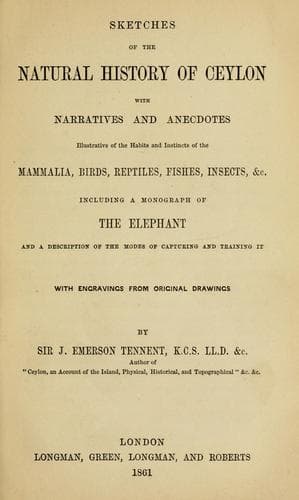
Sketches of the Natural History of CeylonTennent, James Emerson, Sir
Science
Sketches of the Natural History of Ceylon
Tennent, James Emerson, Sir
Animals -- Sri Lanka; Asiatic elephant -- Sri Lanka
matter to kill it; a rifle ball sent diagonally through its breast had
little or no effect, and even when the shot had been repeated more than
once, it was as full of life as ever.[1] It feigned death and lay
motionless, with its eye closed; but, on being pricked with a spear, it
suddenly regained all its activity. It was at last finished by a
harpoon, and then opened. Its maw contained several small tortoises, and
a quantity of broken bricks and gravel, taken medicinally, to promote
digestion.
[Footnote 1: A remarkable instance of the vitality of the common
crocodile, _C. biporcatus_, was related to me by a gentleman at Galle:
he had caught on a baited hook an unusually large one, which his coolies
disembowelled, the aperture in the stomach being left expanded by a
stick placed across it. On returning in the afternoon with a view to
secure the head, they found that the creature had crawled for some
distance, and made its escape into the water.
"A curious incident occurred some years ago on the Maguruganga, a stream
which flows through the Pasdun Corle, to join the Bentolle river. A man
was fishing seated on the branch of a tree that overhung the water; and
to shelter himself from the drizzling rain, he covered his head and
shoulder with a bag folded into a shape common with the natives. While
in this attitude, a leopard sprang upon him from the jungle, but missing
its aim, seized the bag and not the man, and fell with it into the
river. Here a crocodile, which had been eyeing the angler is despair,
seized the leopard as it fell, and sunk with it to the
bottom."--_Letter_ from GOONE-RATNE Modliar, interpreter of the Supreme
Court, 10th Jany., 1861.]
During our journeys we had numerous opportunities of observing the
habits of these hideous creatures, and I am far from considering them so
formidable as they are usually supposed to be. They are evidently not
wantonly destructive; they act only under the influence of hunger, and
even then their motions on land are awkward and ungainly, their action
timid, and their whole demeanour devoid of the sagacity and courage
which characterise other animals of prey.
Public-domain text, read in full here on John Shaqi.
Reviews
Reviews
No reviews yet
Be the first to share your thoughts on this work.
Elsewhere in the archive
Join the Discussion
Join the discussion
Sign in to leave a comment or review.
Sign InorCreate an account