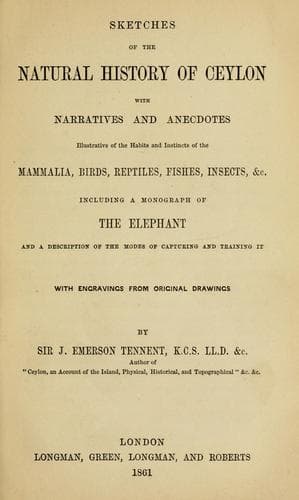
Sketches of the Natural History of CeylonTennent, James Emerson, Sir
Science
Sketches of the Natural History of Ceylon
Tennent, James Emerson, Sir
Animals -- Sri Lanka; Asiatic elephant -- Sri Lanka
The Singhalese remark that if one cobra be destroyed near a house, its
companion is almost certain to be discovered immediately after,--a
popular belief which I had an opportunity of verifying on more than one
occasion. Once, when a snake of this description was killed in a bath of
the Government House at Colombo, its mate was found in the same spot the
day after; and again, at my own stables, a cobra of five feet long,
having fallen into the well, which was too deep to permit its escape,
its companion of the same size was found the same morning in an
adjoining drain.[1] On this occasion the snake, which had been several
hours in the well, swam with ease, raising its head and hood above
water; and instances have repeatedly occurred of the cobra de capello
voluntarily taking considerable excursions by sea. When the
"Wellington," a government vessel employed in the conservancy of the
pearl banks, was anchored about a quarter of a mile from the land, in
the bay of Koodremalé, a cobra was seen, about an hour before sunset,
swimming vigorously towards the ship. It came within twelve yards, when
the sailors assailed it with billets of wood and other missiles, and
forced it to return to land. The following morning they discovered the
track which it had left on the shore, and traced it along the sand till
it was lost in the jungle. On a later occasion, in the vicinity of the
same spot, when the "Wellington" was lying at some distance from the
shore, a cobra was found and killed on board, where it could only have
gained access by climbing up the cable. It was first discovered by a
sailor, who felt the chill as it glided over his foot.
[Footnote 1: PLINY notices the affection that subsists between the male
and female asp; and that if one of them happens to be killed, the other
seeks to avenge its death.--Lib. viii. c. 37.]
One curious tradition in Ceylon embodies the popular legend, that the
stomach of the cobra de capello occasionally contains a precious stone
of such unapproachable brilliancy as to surpass all known jewels. This
inestimable stone is called the _n[=a]ga-m[=a]nik-kya_; but not one
snake in thousands is supposed to possess such a treasure. The cobra,
before eating, is believed to cast it up and conceal it for the moment;
else its splendour, like a flambeau, would attract all beholders. The
tales of the peasantry, in relation to it, all turn upon the devices of
those in search of the gem, and the vigilance and cunning of the cobra
by which they are baffled; the reptile itself being more enamoured of
the priceless jewel than even its most ardent pursuers.
Public-domain text, read in full here on John Shaqi.
Reviews
Reviews
No reviews yet
Be the first to share your thoughts on this work.
Elsewhere in the archive
Join the Discussion
Join the discussion
Sign in to leave a comment or review.
Sign InorCreate an account