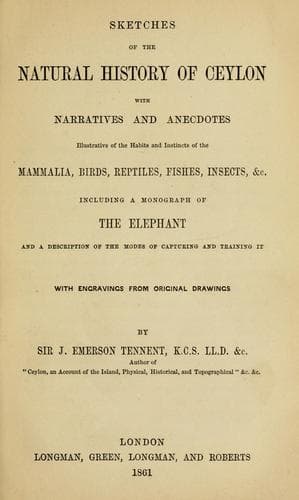
Sketches of the Natural History of CeylonTennent, James Emerson, Sir
Science
Sketches of the Natural History of Ceylon
Tennent, James Emerson, Sir
Animals -- Sri Lanka; Asiatic elephant -- Sri Lanka
On the rocks in Ceylon which are washed by the surf there are quantities
of the curious little fish, _Salarius alticus_[1], which possesses the
faculty of darting along the surface of the water, and running up the
wet stones, with the utmost ease and rapidity. By aid of the pectoral
and ventral fins and gill-cases, they move across the damp sand, ascend
the roots of the mangroves, and climb up the smooth face of the rocks in
search of flies; adhering so securely as not to be detached by repeated
assaults of the waves. These little creatures are so nimble, that it is
almost impossible to lay hold of them, as they scramble to the edge, and
plunge into the sea on the slightest attempt to molest them. They are
from three to four inches in length, and of a dark brown colour, almost
undistinguishable from the rocks they frequent.
[Footnote 1: Cuv. and VALEN., _Hist. Nat. des Poissons_, tom. xi. p.
249. It is identical with _S. tridactylus,_ Schn.]
But the most striking to the eye of a stranger are those fishes whose
brilliancy of colouring has won for them the wonder even of the listless
Singhalese. Some, like the Red Sea Perch (_Holocentrum rubrum_, Forsk)
and the Great Fire Fish[1], are of the deepest scarlet and flame colour;
in others purple predominates, as in the _Serranus flavo-cæruleus_; in
others yellow, as in the _Choetodon Brownriggii_[2], and _Acanthurus
vittatus_, of Bennett[3], and numbers, from the lustrous green of their
scales, have obtained from the natives the appropriate name of
_Giraway_, or _parrots_, of which one, the _Sparus Hardwickii_ of
Bennett, is called the "Flower Parrot," from its exquisite colouring,
being barred with irregular bands of blue, crimson, and purple, green,
yellow, and grey, and crossed by perpendicular stripes of black.
[Footnote 1: _Pterois muricata_, Cuv. and Val. iv. 363. _Scarpæna
miles_, Bennett; named, by the Singhalese, "_Maharata-gini_," the Great
Red Fire, a very brilliant red species spotted with black. It is very
voracious, and is regarded on some parts of the coast as edible, while
on others it is rejected.]
[Footnote 2: _Glyphisodon Brownriggii_, Cuv. and Val. v. 484; _Choetodon
Brownriggii_, Bennett. A very small fish about two inches long, called
_Kaha hartikyha_ by the natives. It is distinct from Choetodon, in which
BENNETT placed it. Numerous species of this genus are scattered
throughout the Indian Ocean. It derives its name from the fine hair-like
character of its teeth. They are found chiefly among coral reefs, and,
though eaten, are not much esteemed. In the French colonies they are
called "Chauffe-soleil." One species is found on the shores of the New
World (_G. saxatalis_), and it is curious that Messrs. QUOY and GAIMARD
found this fish at the Cape de Verde Islands in 1827.]
Public-domain text, read in full here on John Shaqi.
Reviews
Reviews
No reviews yet
Be the first to share your thoughts on this work.
Elsewhere in the archive
Join the Discussion
Join the discussion
Sign in to leave a comment or review.
Sign InorCreate an account