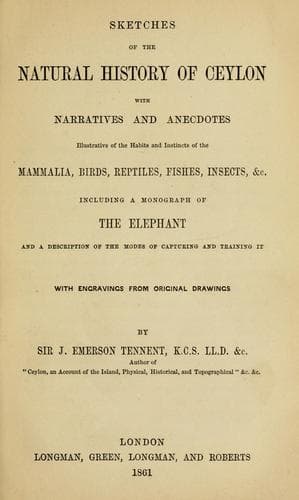
Sketches of the Natural History of CeylonTennent, James Emerson, Sir
Science
Sketches of the Natural History of Ceylon
Tennent, James Emerson, Sir
Animals -- Sri Lanka; Asiatic elephant -- Sri Lanka
In the fishes of Ceylon, however, beauty is not confined to the
brilliancy of their tints. In some, as in the _/Scarus harid_, Forsk[1],
the arrangement of the scales is so graceful, and the effect is so
heightened by modifications of colour, as to present the appearance of
tessellation, or mosaic work.
[Footnote 1: This is the fish figured by BENNETT as _Sparus pepo_.
_Fishes of Ceylon_, Plate xxviii.]
[Illustration: SCARUS HARID. After Bennett.]
_Fresh-water Fishes_.--Of the fresh-water fish, which inhabit the rivers
and tanks, so very little has hitherto been known to naturalists[1],
that of nineteen drawings sent home by Major Skinner in 1852, although
specimens of well-known genera, Colonel Hamilton Smith pronounced nearly
the whole to be new and undescribed species.
[Footnote 1: In extenuation of the little that is known of the
fresh-water fishes of Ceylon, it may be observed that very few of them
are used at table by Europeans, and there is therefore no stimulus on
the part of the natives to catch them. The burbot and grey mullet are
occasionally eaten, but they taste of mud, and are not in request.
Some years ago the experiment was made, with success, of introducing
into Mauritius the _Osphromenus olfax_ of Java, which has also been
taken to French Guiana. In both places it is now highly esteemed as a
fish for table. As it belongs to a family which possesses the faculty,
hereafter alluded to, of surviving in the damp soil after the subsidence
of the water in the tanks and rivers, it might with equal advantage be
acclimated in Ceylon. It grows to 20 lbs. weight and upwards.]
Of eight of these, which were from the Mahawelliganga, and caught in the
vicinity of Kandy, five were carps; two were _Leucisci_, and one a
_Mastacembelus_ (_M. armatus_, Lacep); one was an _Ophiocephalus_, and
one a _Polyacanthus_, with no serræ on the gills. Six were from the
Kalanyganga, close to Colombo, of which two were _Helostoma_, in shape
approaching the Chætodon; two _Ophiocephali_, one a _Silurus_, and one
an _Anabas_, but the gills were without denticulation. From the still
water of the lake, close to the walls of Colombo, there were two species
of _Eleotris_, one _Silurus_ with barbels, and two _Malacopterygians_,
which appear to be _Bagri_.
Public-domain text, read in full here on John Shaqi.
Reviews
Reviews
No reviews yet
Be the first to share your thoughts on this work.
Elsewhere in the archive
Join the Discussion
Join the discussion
Sign in to leave a comment or review.
Sign InorCreate an account