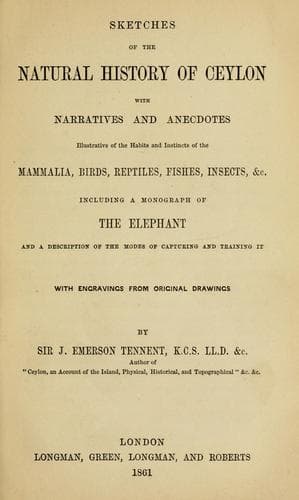
Sketches of the Natural History of CeylonTennent, James Emerson, Sir
Science
Sketches of the Natural History of Ceylon
Tennent, James Emerson, Sir
Animals -- Sri Lanka; Asiatic elephant -- Sri Lanka
The individual most frequently seen in these excursions in Ceylon is a
perch called by the Singhalese _Kavaya_ or _Kawhy-ya_, and by the Tamils
_Pannei-eri_, or _Sennal_. It is closely allied to the _Anabas scandens_
of Cuvier, the _Perca scandens_ of Daldorf. It grows to about six inches
in length, the head round and covered with scales, and the edges of the
gill-covers strongly denticulated. Aided by the apparatus already
adverted to in its head, this little creature issues boldly from its
native pools and addresses itself to its toilsome march generally at
night or in the early morning, whilst the grass is still damp with the
dew; but in its distress it is sometimes compelled to move by day, and
Mr. E.L. Layard on one occasion encountered a number of them travelling
along a hot and dusty road under the midday sun.[1]
[Footnote 1: _Annals and Mag. of Nat. Hist_., May, 1853, p. 390. Mr.
Morris, the government-agent of Trincomalie, writing to me on this
subject in 1856, says--"I was lately on duty inspecting the kind of a
large tank at Nade-cadua, which, being out of repair, the remaining
water was confined in a small hollow in the otherwise dry bed. Whilst
there heavy rain came on, and, as we stood on the high ground, we,
observed a pelican on the margin of the shallow pool gorging himself;
our people went towards him and raised a cry of fish! fish! We hurried
down, and found numbers of fish struggling upwards through the grass in
the rills formed by the trickling of the rain. There was scarcely water
enough to cover them, but nevertheless they made rapid progress up the
bank, on which our followers collected about two bushels of them at a
distance of forty yards from the tank. They were forcing their way up
the knoll, and, had they not been intercepted first by the pelican and
afterwards by ourselves, they would in a few minutes have gained the
highest point and descended on the other side into a pool which formed
another portion of the tank. They were chub, the same as are found in
the mud after the tanks dry up." In a subsequent communication in July,
1857, the same gentleman says--"As the tanks dry up the fish congregate
in the little pools till at last you find them in thousands in the
moistest parts of the beds, rolling in the blue mud which is at that
time about the consistence of thick gruel."
Public-domain text, read in full here on John Shaqi.
Reviews
Reviews
No reviews yet
Be the first to share your thoughts on this work.
Elsewhere in the archive
Join the Discussion
Join the discussion
Sign in to leave a comment or review.
Sign InorCreate an account