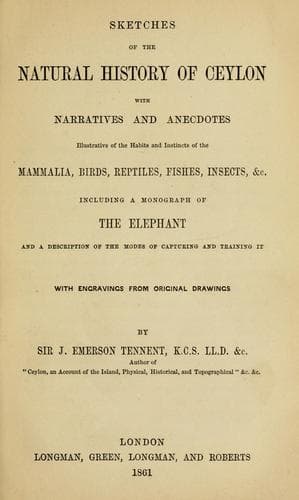
Sketches of the Natural History of CeylonTennent, James Emerson, Sir
Science
Sketches of the Natural History of Ceylon
Tennent, James Emerson, Sir
Animals -- Sri Lanka; Asiatic elephant -- Sri Lanka
[Footnote 2: _Transactions Linn. Soc._ vol. iii. p. 63. It is
remarkable, however, that this discovery of Daldorf, which excited so
great an interest in 1791, had been anticipated by an Arabian voyager a
thousand years before. Abou-zeyd, the compiler of the remarkable MS.
known since Renaudot's translation by the title of the _Travels of the
Two Mahometans_, states that Suleyman, one of his informants, who
visited India at the close of the ninth century, was told there of a
fish which, issuing from the waters, ascended the coco-nut palms to
drink their sap, and returned to the sea. "On parle d'un poisson de mer
qui, sortant de l'eau, monte sur la cocotier et boit le suc de la
plante; ensuite il retourne á la mer." See REINAUD, _Rélations des
Voyages faits par les Arabes et Persans dans le neuvième siècle_, tom.
i. p, 21, tom. ii. p. 93.]
There is considerable obscurity about the story of this ascent, although
corroborated by M. JOHN. Its motive for climbing is not apparent, since
water being close at hand it could not have gone for sake of the
moisture contained in the fissures of the palm; nor could it be in
search of food, as it lives not on fruit but on aquatic insects.[1] The
descent, too, is a question of difficulty.
[Footnote 1: Kirby says that it is "in pursuit of certain crustaceans
that form its food" (_Bridgewater Treatise_, vol i. p. 144); but I am
not aware of any crustaceans in the island which ascend the palmyra or
feed upon its fruit. The _Birgus latro_, which inhabits Mauritius, and
is said to climb the coco-nut for this purpose, has not been observed in
Ceylon.]
The position of its fins, and the spines on its gill-covers, might
assist its journey upwards, but the same apparatus would prove anything
but a facility in steadying its journey down. The probability is, as
suggested by Buchanan, that the ascent which was witnessed by Daldorf
was accidental, and ought not to be regarded as the habit of the animal.
In Ceylon I heard of no instance of the perch ascending trees[1], but
the fact is well established that both it, the _pullata_ (a species of
_polyacanthus_), and others, are capable of long journeys on the level
ground.[2]
[Footnote 1: This assertion must be qualified by a fact stated by Mr.
E.A. Layard, who mentions that on visiting one of the fishing stations
on a Singhalese river, where the fish are caught in staked enclosures,
as described at p. 342, and observing that the chambers were covered
with netting, he asked the reason, and was told "_that some of the fish
climbed up the sticks and got over._"--Mag. Nat. Hist, for May 1823, p.
390-1.]
Public-domain text, read in full here on John Shaqi.
Reviews
Reviews
No reviews yet
Be the first to share your thoughts on this work.
Elsewhere in the archive
Join the Discussion
Join the discussion
Sign in to leave a comment or review.
Sign InorCreate an account