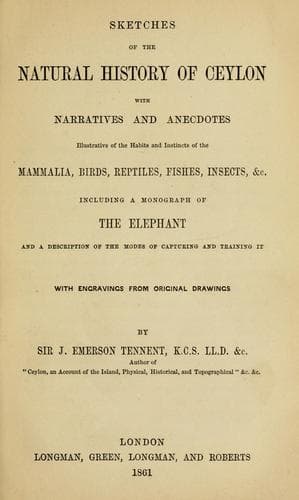
Sketches of the Natural History of CeylonTennent, James Emerson, Sir
Science
Sketches of the Natural History of Ceylon
Tennent, James Emerson, Sir
Animals -- Sri Lanka; Asiatic elephant -- Sri Lanka
[Footnote 2: This statement will be found in QUATREMERE'S Mémoires sur
l'Egypte, tom. i. p. 17, on the authority of Abdullah ben Ahmed ben
Solaim Assouany, in his _History of Nubia_, "Simon, héritier présomptif
du royanme d'Alouah, m'a assuré que l'on trouve, dans la vase qui couvre
fond de cette rivière, un grand poisson sans écailles, qui ne ressemble
en rien aux poissons du Nil, et que, pour l'avoir, il faut creuser à une
toise et plus de profondeur." To this passage, there is appended this
note:--"Le patriarche Mendes, cité par Legrand (_Relation Hist. d'
Abyssinie_, du P. LOBO, p. 212-3) rapporte que le fleuve Mareb, après
avoir arrosé une étendue de pays considérable, se perd sous terre; et
que quand les Portugais faisaient la guerre dans ce pays, ils
fouilloient dans le sable, et y trouvoient de la bonne eau et du ban
poisson. An rapport de l'auteur de _l' Ayin Akbery_ (tom. ii, p. 146,
ed. 1800), dans le Soubah do Caschmir, pres du lieu nommé Tilahmoulah,
est une grande pièce de terre qui est inondée pendant la saison des
pluies. Lorsque les eaux se sont évaporées, et que la vase est presque
séche, les habitans prennant des bâtons d'environ une aune do long,
qu'ils enfoncent dans la vase, et ils y trouvent quantité de grands et
petits poissons." In the library of the British Museum there is an
unique MS. of MANOEL DE ALMEIDA, written in the sixteenth century, from
which Balthasar Tellec compiled his _Historia General de Ethiopia alta_,
printed at Coimbra in 1660, and in it the above statement of Mendes is
corroborated by Almeida, who says that he was told by João Gabriel, a
Creole Portuguese, born in Abyssinia, who had visited the Mareb, and who
said that the "fish were to be found everywhere eight or ten palms down,
and that he had eaten of them."]
In South America the "round-headed hassar" of Guiana, _Callicthys
littoralis_, and the "yarrow," a species of the family Esocidæ, although
they possess no specially modified respiratory organs, are accustomed to
bury themselves in the mud on the subsidence of water in the pools
during the dry season.[1] The _Loricaria_ of Surinam, another Siluridan,
exhibits a similar instinct, and resorts to the same expedient. Sir R.
Schomburgk, in his account of the fishes of Guiana, confirms this
account of the Callicthys, and says "they can exist in muddy lakes
without any water whatever, and great numbers of them are sometimes dug
up from such situations."[2]
[Footnote 1: See Paper "_on some Species of Fishes and Reptiles in
Demerara_," by J. HANDCOCK, Esq., M.D., _Zoological Journal_, vol. iv.
p. 243.]
[Footnote 2: A curious account of the _borachung_ or "ground fish" of
Bhootan, will be found in Note (C.) appended to this chapter.]
Public-domain text, read in full here on John Shaqi.
Reviews
Reviews
No reviews yet
Be the first to share your thoughts on this work.
Elsewhere in the archive
Join the Discussion
Join the discussion
Sign in to leave a comment or review.
Sign InorCreate an account