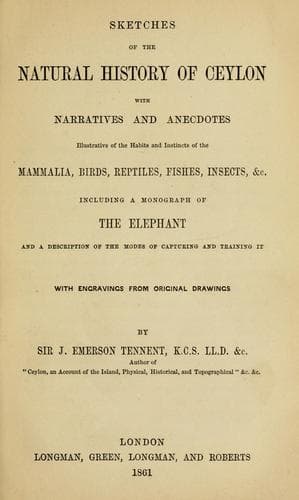
Sketches of the Natural History of CeylonTennent, James Emerson, Sir
Science
Sketches of the Natural History of Ceylon
Tennent, James Emerson, Sir
Animals -- Sri Lanka; Asiatic elephant -- Sri Lanka
of rain, multitudes of fish were caught on the ground in the
cantonments, full half a mile from the nearest stream. If showers of
fish are to be explained on the assumption that they are carried up by
squalls or violent winds, from rivers or spaces of water not far away
from where they fall, it would be nothing wonderful were they seen to
descend from the air during the furious squalls which occasionally occur
in June."
* * * * *
NOTE (B.)
CEYLON FISHES.
(_Memorandum by Professor Huxley._)
See Page 324.
The large series of beautifully coloured drawings of the fishes of
Ceylon, which has been submitted to my inspection, possesses an unusual
value for several reasons.
The fishes, it appears, were all captured at Colombo, and even had those
from other parts of Ceylon been added, the geographical area would not
have been very extended. Nevertheless there are more than 600 drawings,
and though it is possible that some of these represent varieties in
different stages of growth of the same species, I have not been able to
find definite evidence of the fact in any of those groups which I have
particularly tested. If, however, these drawings represent _six hundred_
distinct species of fish, they constitute, so far as I know, the largest
collection of fish from one locality in existence.
The number of known British fishes may be safely assumed to be less than
250, and Mr. Yarrell enumerates only 226, Dr. Cantor's valuable work on
Malayan fishes enumerates not more than 238, while Dr. Russell has
figured only 200 from Coromandel. Even the enormous area of the Chinese
and Japanese seas has as yet not yielded 800 species of fishes.
The large extent of the collection alone, then, renders it of great
importance: but its value is immeasurably enhanced by the two
circumstances,--_first_, that every drawing was made while the fish
retained all that vividness of colouring which becomes lost so soon
after its removal from its native element; and _secondly_, that when the
sketch was finished its subject was carefully labelled, preserved in
spirits, and forwarded to England, so that at the present moment the
original of every drawing can be subjected to anatomical examination,
and compared with already named species.
Under these circumstances, I do not hesitate to say that the collection
is one of the most valuable in existence, and might, if properly worked
out, become a large and secure foundation for all future investigation
into the ichthyology of the Indian Ocean.
It would be very hazardous to express an opinion as to the novelty or
otherwise of the species and genera figured without the study of the
specimens themselves, as the specific distinctions of fish are for the
most part based upon character--the fin-rays, teeth, the operculum, &c.,
which can only be made out by close and careful examination of the
object, and cannot be represented in ordinary drawings however accurate.
Public-domain text, read in full here on John Shaqi.
Reviews
Reviews
No reviews yet
Be the first to share your thoughts on this work.
Elsewhere in the archive
Join the Discussion
Join the discussion
Sign in to leave a comment or review.
Sign InorCreate an account