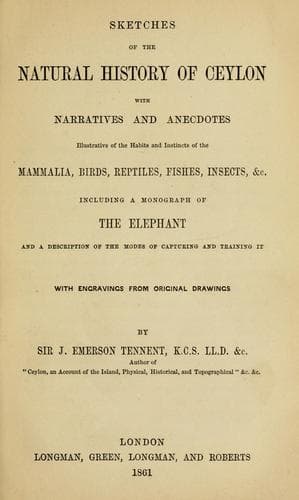
Sketches of the Natural History of CeylonTennent, James Emerson, Sir
Science
Sketches of the Natural History of Ceylon
Tennent, James Emerson, Sir
Animals -- Sri Lanka; Asiatic elephant -- Sri Lanka
In Bhootan, at the south-eastern extremity of the Himalayas, a fish is
found, the scientific name of which is unknown to me, but it is called
by the natives the _Bora-chung_, and by European residents the
"ground-fish of Bhootan." It is described in the _Journal of the Asiatic
Society of Bengal for_ 1839, by a writer (who had seen it alive), as
being about two feet in length, and cylindrical, with a thick body,
somewhat shaped like a pike, but rounder, the nose curved upwards, the
colour olive-green, with orange stripes, and the head speckled with
crimson.[1] This fish, according to the native story, is caught not in
the rivers in whose vicinity it is found, but "in perfectly dry places
in the middle of grassy jungle, sometimes as far as two miles from the
banks." Here, on finding a hole four or five inches in diameter, they
commence to dig, and continue till they come to water; and presently the
_bora-chung_ rises to the surface, sometimes from a depth of nineteen
feet. In these extemporised wells these fishes are found always in
pairs, and I when brought to the surface they glide rapidly over the
ground with a serpentine motion. This account appeared in 1839; but some
years later, Mr. Campbell, the Superintendent of Darjeeling, in a
communication to the same journal[2], divested the story of much of its
exaggeration, by stating, as the result of personal inquiry in Bhootan,
that the _bora-chung_ inhabits the jheels and slow-running streams near
the hills, but lives principally on the banks, into which it penetrates
from one to five or six feet. The entrance to these retreats leading
from the river into the bank is generally a few inches below the
surface, so that the fish can return to the water at pleasure. The mode
of catching them is by introducing the hand into these holes; and the
_bora-chungs_ are found generally two in each chamber, coiled
concentrically like snakes. It is not believed that they bore their own
burrows, but that they take possession of those made by land-crabs. Mr.
Campbell denies that they are more capable than other fish of moving on
dry ground. From the particulars given, the _bora-chung_ would appear to
be an _Ophiocephalus_, probably the _O. barka_ described by Buchanan, as
inhabiting holes in the banks of rivers tributary to the Ganges.
[Footnote 1: Paper by Mr. J.T. PEARSON, _Journ. Asiat. Soc. Beng._, vol.
viii p. 551.]
[Footnote 2: _Journ. Asiat. Soc. Beng._, vol. xi. p. 963.]
CHAP. XI.
SHELLS.
* * * * *
_Mollusca.--Radiata, &c._
Public-domain text, read in full here on John Shaqi.
Reviews
Reviews
No reviews yet
Be the first to share your thoughts on this work.
Elsewhere in the archive
Join the Discussion
Join the discussion
Sign in to leave a comment or review.
Sign InorCreate an account