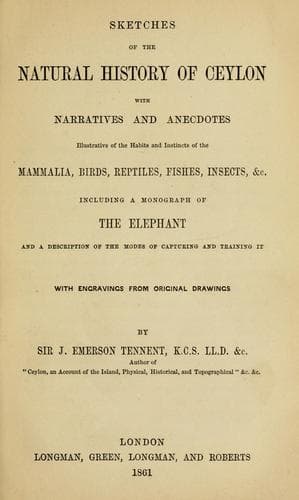
Sketches of the Natural History of CeylonTennent, James Emerson, Sir
Science
Sketches of the Natural History of Ceylon
Tennent, James Emerson, Sir
Animals -- Sri Lanka; Asiatic elephant -- Sri Lanka
[Footnote 3: _Rapport de_ M. COSTE, Professeur d'Embryogénie, &c.,
Paris, 1858.]
On my arrival at Aripo, the pearl-divers, under the orders of their
Adapanaar, put to sea, and commenced the examination of the banks.[1]
The persons engaged in this calling are chiefly Tamils and Moors, who
are trained for the service by diving for chanks. The pieces of
apparatus employed to assist the diver in his operations are exceedingly
simple in their character: they consist merely of a stone, about thirty
pounds' weight, (to accelerate the rapidity of his descent,) which is
suspended over the side of the boat, with a loop attached to it for
receiving the foot; and of a net-work basket, which he takes down to the
bottom and fills with the oysters as he collects them. MASSOUDI, one of
the earliest Arabian geographers, describing, in the ninth century, the
habits of the pearl-divers in the Persian Gulf, says that, before
descending, each filled his ears with cotton steeped in oil, and
compressed his nostrils by a piece of tortoise-shell.[2] This practice
continues there to the present day[3]; but the diver of Ceylon rejects
all such expedients; he inserts his foot in the "sinking stone" and
inhales a full breath; presses his nostrils with his left hand; raises
his body as high as possible above water, to give force to his descent:
and, liberating the stone from its fastenings, he sinks rapidly below
the surface. As soon as he has reached the bottom, the stone is drawn
up, and the diver, throwing himself on his face, commences with alacrity
to fill his basket with oysters. This, on a concerted signal, is hauled
rapidly to the surface; the diver assisting his own ascent by springing
on the rope as it rises.
[Footnote 1: Detailed accounts of the pearl fishery of Ceylon and the
conduct of the divers, will be found in PERCIVAL's _Ceylon_, ch. iii.:
and in CORDINER'S _Ceylon_, vol. ii. ch. xvi. There is also a valuable
paper on the same subject by Mr. LE BECK, in the _Asiatic Researches_,
vol. v. p. 993; but by far the most able and intelligent description is
contained in the _Account of the Pearl Fisheries of Ceylon_, by JAMES
STEUART, Esq., Inspector of the Pearl Banks, 4to. Colombo, 1843.]
[Footnote 2: MASSOUDI says that the Persian divers, as they could not
breathe through their nostrils, _cleft the root of the ear_ for that
purpose: "_Ils se fendaient la racine de l'oreille pour respirer_; en
effet, ils ne peuvent se servir pour cet objet des narines, vu qu'ils se
les bouchent avec des morceaux d'écailles de tortue marine on bien avec
des morceaux de corne ayant la forme d'un fer de lance. En même temps
ils se mettent dans l'oreille du coton trempé dans de
l'huile."--_Moroudj-al-Dzeheb,_ &c., REINAUD, _Mémoire sur l'Inde,_ p.
228.]
[Footnote 3: Colonel WILSON says they compress the nose with horn, and
close the ears with beeswax. See _Memorandum on the Pearl Fisheries in
Persian Gulf.--Journ. Geogr. Soc._ 1833, vol. iii. p. 283.]
Public-domain text, read in full here on John Shaqi.
Reviews
Reviews
No reviews yet
Be the first to share your thoughts on this work.
Elsewhere in the archive
Join the Discussion
Join the discussion
Sign in to leave a comment or review.
Sign InorCreate an account