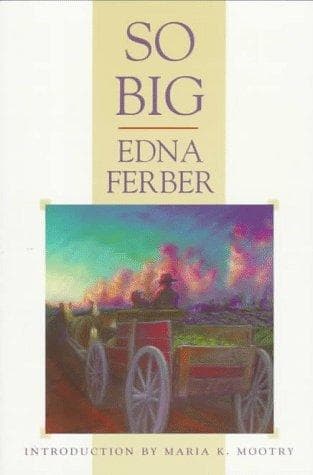
Bildungsromans; Chicago (Ill.) -- Fiction; Domestic fiction; Fathers and daughters -- Fiction; Gamblers -- Family relationships -- Fiction
Edna Ferber is an arresting personality. In speech, in appearance, and
in manner she stands out clear against the mass.
Anyone who really knows her realizes why her stories, both long and
short, reach the understanding and touch the hearts of the readers. One
is very likely to say, “Why, I know somebody like that,” or “I knew she
would do that.”
She knows folks, all sorts of people, but she is interested chiefly in
people who do things: not the men who run great corporations and control
the destinies of thousands of men and women, but the men and women who
have jobs, and under that classification come that vast number who run
modest households, who struggle to bring up children, who, in fact, form
the permanent solid stratum on which our society is built.
She has the large-minded sympathy that makes for understanding of the
under dog. She will take French lessons, not only because she wants to
study the language, but because a cultivated Frenchman needs money and
will not accept charity.
Edna Ferber enjoys a talk with a washwoman and the woman enjoys the talk
too. Her colored maid adores her—and imposes on her (as is the way with
colored maids).
She hates pretension and is very likely to speak her mind not only to
her intimates but straight to the face of the objectionable person.
Sometimes she speaks more strongly than she should, for she is impulsive
and quick-tempered, but no one is more generous than she in the
acknowledgment of mistakes.
Her letters are characteristic. They just begin. No salutation, no
sparring for an opening—they begin at the beginning and when she is
through she stops. She just adds her initials.
She stands on her own small feet. If you say to her, “The mantle of O.
Henry has fallen on your shoulders” (it has been said with complimentary
intent), you will get a flash from her black eyes that will scorch you
and a rush of words that will make you wish you were elsewhere. She does
not want anyone’s else mantle or footgear for that matter—she is
herself, Edna Ferber.
Her earlier picturesque, sometimes flippant style, the surprise
climaxes, and the short pithy sentences, come from her newspaper
experience and not from any influence of O. Henry. The newspaper
editor’s command is to “tell the story and make it snappy,” and it has
affected Edna Ferber’s style, as it has affected the work of many other
writers who grew out of newspaper offices.
Her style has changed as all thoughtful readers must have noticed. The
literary form of the Emma McChesney stories is quite different from that
of the stories in “Cheerful by Request” and “Gigolo.” Read a story in
“Roast Beef Medium” and then read “Old Man Minick.”
There is a depth and richness, a dignity and soundness, that the earlier
works lacked. Yet there is no loss of strength and vital freshness in
her later books.
Public-domain text, read in full here on John Shaqi.
Reviews
Reviews
No reviews yet
Be the first to share your thoughts on this work.
Elsewhere in the archive
Join the Discussion
Join the discussion
Sign in to leave a comment or review.
Sign InorCreate an account