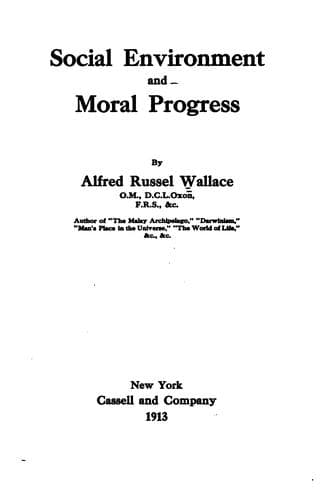
Social Environment and Moral ProgressWallace, Alfred Russel
Philosophy
Social Environment and Moral Progress
Wallace, Alfred Russel
Natural selection; Social ethics
We must also take account of a special factor, hitherto almost
unnoticed, which would tend to intensify the selection thus exercised.
It is a fact well known to statisticians that although females are
in excess in almost all civilised populations, yet this is not due
to a law of Nature; for with us, and I believe in all parts of the
Continent, more males than females are born to an amount of about
3½ to 4 per cent. But between the ages of five and thirty-five there
were, in 1910, 4·225 deaths of males from accident or violence and only
1·300 of females, showing an excess of male deaths of 2·925 in one
year; and for many years the numbers of this class of deaths have not
varied much, the excess of preventable deaths of males at those ages
being very nearly 3,000 annually. This excess is no doubt due to boys
and young men being more exposed, both in play and work, to various
kinds of accidents than are women, and this brings about the constant
excess of females in what may be termed normal civilised populations.
In 1901 it was about a million; while fifty years earlier, when the
population was about half, it was only 359,000, or considerably less
than half the present proportion. This is what we should expect from
the constant increase of accidents and of emigration, the effects of
both of which fall most upon males.
It appears, therefore, that the larger number of women in our
population to-day is not a natural phenomenon, but is almost wholly
the result of our own man-made social environment. When the lives
of _all_ our citizens are accounted of equal value to the community,
irrespective of class or of wealth, a much smaller number will
be allowed to suffer from such preventable causes; while, as our
colonies fill up with a normal population, and the enormous areas of
uncultivated or half-cultivated land at home are thrown open to our
own people on the most favourable terms, the great tide of emigration
will be diminished and will then cease to affect the proportion of the
sexes. The result of these various causes, now all tending to increase
the numbers of the female population, will, in a rational and just
system of society, of which we may hope soon to see the commencement,
act in a contrary direction, and will in a few generations bring the
sexes first to an equality, and later on to a majority of males.
Public-domain text, read in full here on John Shaqi.
Reviews
Reviews
No reviews yet
Be the first to share your thoughts on this work.
Join the Discussion
Join the discussion
Sign in to leave a comment or review.
Sign InorCreate an account