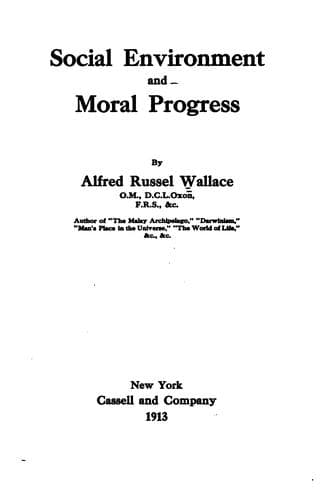
Social Environment and Moral ProgressWallace, Alfred Russel
Philosophy
Social Environment and Moral Progress
Wallace, Alfred Russel
Natural selection; Social ethics
There are some, no doubt, who will object that even when women have
a free choice, owing to improved economic conditions, they will not
choose wisely so as to advance the race. But no one has the right to
make such a statement without adducing very strong evidence in support
of it. We have for generations degraded women in every possible way;
but we now know that such degradation is not hereditary, and therefore
not permanent. The great philosopher and seer, Swedenborg, declared
that whereas men loved justice, wisdom and power for their own sakes,
women loved them as seen in the characters of men. It is generally
admitted that there is truth in this observation; but there is surely
still more truth in the converse, that they do not admire those men
who are palpably unjust, stupid, or weak, and still less those who
are distorted, diseased, or grossly vicious, though under present
conditions they are often driven to marry them. It may be taken as
certain, therefore, that when women are economically and socially free
to choose, numbers of the worst men among all classes who now readily
obtain wives _will be almost universally rejected_.
Now, this mode of improvement by elimination of the less desirable
has many advantages over that of securing early marriages of the more
admired; for what we most require is to improve the _average_ of our
population by rejecting its lower types rather than by raising the
advanced types a little higher. Great and good men are always produced
in sufficient numbers and have always been so produced in every phase
of civilisation. We do not need more of these so much as we want a
diminution of the weaker and less advanced types. This weeding-out
process has been the method of _natural selection_, by which the whole
of the glorious vegetable and animal kingdoms have been developed and
advanced. The survival of the fittest is really the extinction of the
unfit; and it is the one brilliant ray of hope for humanity that, just
as we advance in the reform of our present cruel and disastrous social
system, we shall set free a power of selection in marriage that will
steadily and certainly improve the character, as well as the strength
and the beauty, of our race.
_Social Reform and Over-population_
One of the most general and apparently the strongest of the objections
to any thorough schemes of social reform, and especially to those that
will abolish want and the constant dread of starvation is that, in
any society in which this is done early marriages will be much more
numerous; there will be no prudential checks to large families; and in
a few generations, as Malthus argued, populations will increase beyond
the means of subsistence. Then will commence a continual decrease of
well-being, culminating in universal poverty, worse than any that now
exists, because it will be universal. The following quotation from an
eminent American writer shows that this fear has really been felt:
Public-domain text, read in full here on John Shaqi.
Reviews
Reviews
No reviews yet
Be the first to share your thoughts on this work.
Elsewhere in the archive
Join the Discussion
Join the discussion
Sign in to leave a comment or review.
Sign InorCreate an account