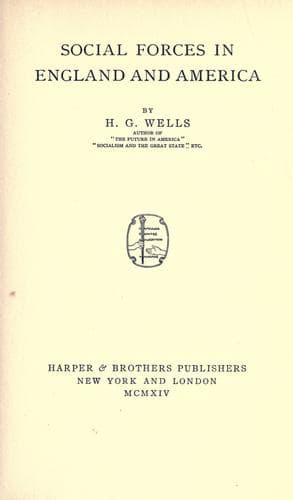
Social Forces in England and AmericaWells, H. G. (Herbert George)
History
Social Forces in England and America
Wells, H. G. (Herbert George)
England -- Social conditions -- 20th century; Social problems; United States -- Social conditions -- 1865-1918
And if the novel is to be recognised as something more than a
relaxation, it has also, I think, to be kept free from the restrictions
imposed upon it by the fierce pedantries of those who would define a
general form for it. Every art nowadays must steer its way between the
rocks of trivial and degrading standards and the whirlpool of arbitrary
and irrational criticism. Whenever criticism of any art becomes
specialised and professional, whenever a class of adjudicators is
brought into existence, those adjudicators are apt to become as a class
distrustful of their immediate impressions, and, anxious for methods of
comparison between work and work, they begin to emulate the
classifications and exact measurements of a science, and to set up
ideals and rules as data for such classification and measurements. They
develop an alleged sense of technique, which is too often no more than
the attempt to exact a laboriousness of method, or to insist upon
peculiarities of method which impress the professional critic not so
much as being merits as being meritorious. This sort of thing has gone
very far with the critical discussion both of the novel and the play.
You have all heard that impressive dictum that some particular
theatrical display, although moving, interesting, and continually
entertaining from start to finish, was for occult technical reasons “not
a play,” and in the same way you are continually having your
appreciation of fiction dashed by the mysterious parallel condemnation,
that the story you like “isn’t a novel.” The novel has been treated as
though its form was as well defined as the sonnet. Some year or so ago,
for example, there was a quite serious discussion, which began, I
believe, in a weekly paper devoted to the interests of various
nonconformist religious organisations, about the proper length for a
novel. The critic was to begin his painful duties with a yard measure.
The matter was taken up with profound gravity by the _Westminster
Gazette_, and a considerable number of literary men and women were
circularised and asked to state, in the face of _Tom Jones_, _The Vicar
of Wakefield_, _The Shabby-Genteel Story_, and _Bleak House_, just
exactly how long the novel ought to be. Our replies varied according to
the civility of our natures, but the mere attempt to raise the question
shows, I think, how widespread among the editorial, paragraph-writing,
opinion-making sort of people is this notion of prescribing a definite
length and a definite form for the novel. In the newspaper
correspondence that followed, our friend the weary giant made a
transitory appearance again. We were told the novel ought to be long
enough for him to take up after dinner and finish before his whisky at
eleven.
Public-domain text, read in full here on John Shaqi.
Reviews
Reviews
No reviews yet
Be the first to share your thoughts on this work.
Elsewhere in the archive
Join the Discussion
Join the discussion
Sign in to leave a comment or review.
Sign InorCreate an account