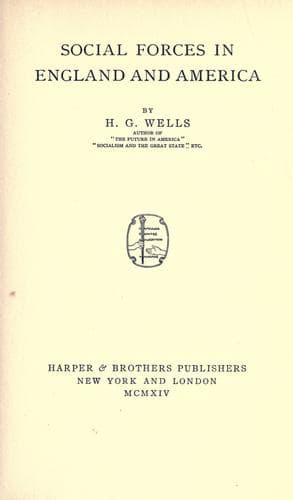
Social Forces in England and AmericaWells, H. G. (Herbert George)
History
Social Forces in England and America
Wells, H. G. (Herbert George)
England -- Social conditions -- 20th century; Social problems; United States -- Social conditions -- 1865-1918
Let us, however, drop the expert methods and handle this question rather
more rudely. Do we want London rebuilt? If we do, is there, after all,
any reason why we should rebuild it on its present site? London is where
it is for reasons that have long ceased to be valid; it grew there, it
has accumulated associations, an immense tradition, that this constant
mucking about of builders and architects is destroying almost as
effectually as removal to a new site. The old sort of rebuilding was a
natural and picturesque process, house by house, and street by street, a
thing as pleasing and almost as natural in effect as the spreading and
interlacing of trees; as this new building, this clearance of areas, the
piercing of avenues, becomes more comprehensive, it becomes less
reasonable. If we can do such big things we may surely attempt bigger
things, so that whether we want to plan a new capital or preserve the
old, it comes at last to the same thing, that it is unreasonable to be
constantly pulling down the London we have and putting it up again. Let
us drain away our heavy traffic into tunnels, set up that clearinghouse
plan, and control the growth at the periphery, which is still so witless
and ugly, and, save for the manifest tidying and preserving that is
needed, begin to leave the central parts of London, which are extremely
interesting even where they are not quite beautiful, in peace.
THE SO-CALLED SCIENCE OF SOCIOLOGY
It has long been generally recognised that there are two quite divergent
ways of attacking sociological and economic questions, one that is
called scientific and one that is not, and I claim no particular virtue
in the recognition of that; but I do claim a certain freshness in my
analysis of this difference, and it is to that analysis that your
attention is now called. When I claim freshness I do not make, you
understand, any claim to original discovery. What I have to say, and
have been saying for some time, is also more or less, and with certain
differences, to be found in the thought of Professor Bosanquet, for
example, in Alfred Sidgwick’s _Use of Words in Reasoning_, in Sigwart’s
_Logic_, in contemporary American metaphysical speculation. I am only
one incidental voice speaking in a general movement of thought. My trend
of thought leads me to deny that sociology is a science, or only a
science in the same loose sense that modern history is a science, and to
throw doubt upon the value of sociology that follows too closely what is
called the scientific method.
The drift of my argument is to dispute not only that sociology is a
science, but also to deny that Herbert Spencer and Comte are to be
exalted as the founders of a new and fruitful system of human inquiry. I
find myself forced to depreciate these modern idols, and to reinstate
the Greek social philosophers in their vacant niches, to ask you rather
to go to Plato for the proper method, the proper way of thinking
sociologically.
Public-domain text, read in full here on John Shaqi.
Reviews
Reviews
No reviews yet
Be the first to share your thoughts on this work.
Elsewhere in the archive
Join the Discussion
Join the discussion
Sign in to leave a comment or review.
Sign InorCreate an account