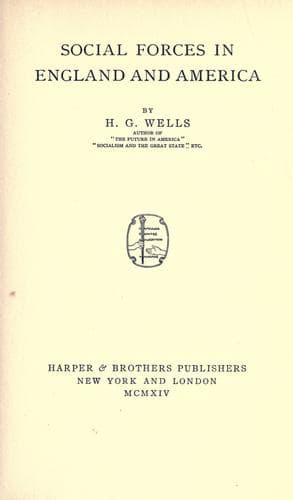
Social Forces in England and AmericaWells, H. G. (Herbert George)
History
Social Forces in England and America
Wells, H. G. (Herbert George)
England -- Social conditions -- 20th century; Social problems; United States -- Social conditions -- 1865-1918
From these two sources mainly the work of contemporary sociologists
derives. But there persists about it a curious discursiveness that
reflects upon the power and value of the initial impetus. Mr. V. V.
Branford, the able secretary of the Sociological Society, recently
attempted a useful work in a classification of the methods of what he
calls “approach,” a word that seems to me eminently judicious and
expressive. A review of the first volume the Sociological Society has
produced brings home the aptness of this image of exploratory
operations, of experiments in “taking a line.” The names of Dr. Beattie
Crozier and Mr. Benjamin Kidd recall works that impress one as
large-scale sketches of a proposed science rather than concrete
beginnings and achievements. The search for an arrangement, a “method,”
continues as though they were not. The desperate resort to the
analogical method of Commenius is confessed by Dr. Steinmetz, who talks
of social morphology, physiology, pathology, and so forth. There is also
a less initiative disposition in the Vicomte Combes de Lestrade and in
the work of Professor Giddings. In other directions sociological work is
apt to lose its general reference altogether, to lapse towards some
department of activity not primarily sociological at all. Examples of
this are the works of Mr. and Mrs. Sidney Webb, M. Ostrogorski and M.
Gustave le Bon. From a contemplation of all this diversity Professor
Durkheim emerges, demanding a “synthetic science,” “certain synthetic
conceptions”—and Professor Karl Pearson endorses the demand—to fuse all
these various activities into something that will live and grow. What is
it that tangles this question so curiously that there is not only a
failure to arrive at a conclusion, but a failure to join issue?
Well, there is a certain, not too clearly recognised, order in the
sciences to which I wish to call your attention, and which forms the
gist of my case against this scientific pretension. There is a gradation
in the importance of the instance as one passes from mechanics and
physics and chemistry, through the biological sciences to economics and
sociology, a gradation whose correlatives and implications have not yet
received adequate recognition, and which do profoundly affect the method
of study and research in each science.
Public-domain text, read in full here on John Shaqi.
Reviews
Reviews
No reviews yet
Be the first to share your thoughts on this work.
Elsewhere in the archive
Join the Discussion
Join the discussion
Sign in to leave a comment or review.
Sign InorCreate an account