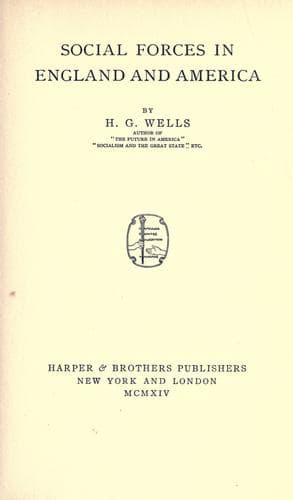
Social Forces in England and AmericaWells, H. G. (Herbert George)
History
Social Forces in England and America
Wells, H. G. (Herbert George)
England -- Social conditions -- 20th century; Social problems; United States -- Social conditions -- 1865-1918
This is most distinctly _not_ an age of specialisation. There has hardly
been an age in the whole course of history less so than the present. A
few moments of reflection will suffice to demonstrate that. This is
beyond any precedent an age of change, change in the appliances of life,
in the average length of life, in the general temper of life; and the
two things are incompatible. It is only under fixed conditions that you
can have men specialising.
They specialise extremely, for example, under such conditions as one had
in Hindustan up to the coming of the present generation. There the metal
worker or the cloth worker, the wheelwright or the druggist of yesterday
did his work under almost exactly the same conditions as his predecessor
did it five hundred years before. He had the same resources, the same
tools, the same materials; he made the same objects for the same ends.
Within the narrow limits thus set him he carried work to a fine
perfection; his hand, his mental character were subdued to his medium.
His dress and bearing even were distinctive; he was, in fact, a highly
specialised man. He transmitted his difference to his sons. Caste was
the logical expression in the social organisation of this state of high
specialisation, and, indeed, what else is caste or any definite class
distinctions but that? But the most obvious fact of the present time is
the disappearance of caste and the fluctuating uncertainty of all class
distinctions.
If one looks into the conditions of industrial employment,
specialisation will be found to linger just in proportion as a trade has
remained unaffected by inventions and innovation. The building trade,
for example, is a fairly conservative one. A brick wall is made to-day
much as it was made two hundred years ago, and the bricklayer is in
consequence a highly skilled and inadaptable specialist. No one who has
not passed through a long and tedious training can lay bricks properly.
And it needs a specialist to plough a field with horses or to drive a
cab through the streets of London. Thatchers, old-fashioned cobblers,
and hand workers are all specialised to a degree no new modern calling
requires. With machinery skill disappears and unspecialised intelligence
comes in. Any generally intelligent man can learn in a day or two to
drive an electric tram, fix up an electric lighting installation, or
guide a building machine or a steam plough. He must be, of course, much
more generally intelligent than the average bricklayer, but he needs far
less specialised skill. To repair machinery requires, of course, a
special sort of knowledge, but not a special sort of training.
Public-domain text, read in full here on John Shaqi.
Reviews
Reviews
No reviews yet
Be the first to share your thoughts on this work.
Elsewhere in the archive
Join the Discussion
Join the discussion
Sign in to leave a comment or review.
Sign InorCreate an account