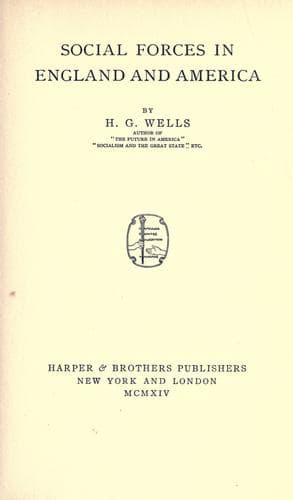
Social Forces in England and AmericaWells, H. G. (Herbert George)
History
Social Forces in England and America
Wells, H. G. (Herbert George)
England -- Social conditions -- 20th century; Social problems; United States -- Social conditions -- 1865-1918
Now, so far as the insurrection of labour goes, American conditions
differ from European, and the process of disillusionment will probably
follow a different course. American labour is very largely immigrant
labour still separated by barriers of language and tradition from the
established thought of the nation. It will be long before labour in
America speaks with the massed effectiveness of labour in France and
England, where master and man are racially identical, and where there is
no variety of “Dagoes” to break up the revolt. But in other directions
the American disbelief in and impatience with “elected persons” is and
has been far profounder than it is in Europe. The abstinence of men of
property and position from overt politics, and the contempt that
banishes political discussion from polite society, are among the first
surprises of the visiting European to America, and now that, under an
organised pressure of conscience, college-trained men and men of wealth
are abandoning this strike of the educated and returning to political
life, it is, one notes, with a prevailing disposition to correct
democracy by personality, and to place affairs in the hands of
autocratic mayors and presidents rather than to carry out democratic
methods to the logical end. At times America seems hot for a Cæsar. If
no Cæsar is established, then it will be the good fortune of the
Republic rather than its democratic virtue which will have saved it.
And directly one comes to look into the quality and composition of the
elected governing body of any modern democratic State, one begins to see
the reason and nature of its widening estrangement from the community it
represents. In no sense are these bodies really representative of the
thought and purpose of the nation; the conception of its science, the
fresh initiatives of its philosophy and literature, the forces that make
the future through invention and experiment, exploration and trial and
industrial development have no voice, or only an accidental and feeble
voice, there. The typical elected person is a smart rather than
substantial lawyer, full of cheap catchwords and elaborate tricks of
procedure and electioneering, professing to serve the interests of the
locality which is his constituency, but actually bound hand and foot to
the specialised political association, his party, which imposed him upon
that constituency. Arrived at the legislature, his next ambition is
office, and to secure and retain office he engages in elaborate
manœuvres against the opposite party, upon issues which his limited and
specialised intelligence indicates as electorally effective. But being
limited and specialised, he is apt to drift completely out of touch with
the interests and feelings of large masses of people in the community.
In Great Britain, the United States and France alike there is a constant
tendency on the part of the legislative body to drift into unreality,
Public-domain text, read in full here on John Shaqi.
Reviews
Reviews
No reviews yet
Be the first to share your thoughts on this work.
Elsewhere in the archive
Join the Discussion
Join the discussion
Sign in to leave a comment or review.
Sign InorCreate an account