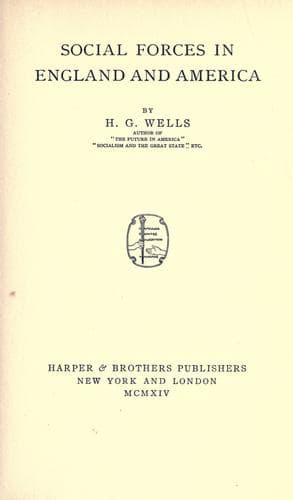
Social Forces in England and AmericaWells, H. G. (Herbert George)
History
Social Forces in England and America
Wells, H. G. (Herbert George)
England -- Social conditions -- 20th century; Social problems; United States -- Social conditions -- 1865-1918
The evidence of the American railways, then, suggests very strongly what
a hundred other signs confirm, that the huge classless sea of American
population is not destined to remain classless, is already developing
separations and distinctions and structures of its own. And monstrous
architectural portents in Boston and Salt Lake City encourage one to
suppose that even that churchless aspect, which so stirred the
speculative element in Mr. Henry James, is only the opening formless
phase of a community destined to produce not only classes but
intellectual and moral forms of the most remarkable kind.
§ 3
It is well to note how these eighty millions of people whose social
future we are discussing are distributed. This huge development of human
appliances and resources is here going on in a community that is still,
for all the dense crowds of New York, the teeming congestion of East
Side, extraordinarily scattered. America, one recalls, is still an
unoccupied country across which the latest developments of civilisation
are rushing. We are dealing here with a continuous area of land which
is, leaving Alaska out of account altogether, equal to Great Britain,
France, the German Empire, the Austro-Hungarian Empire, Italy, Belgium,
Japan, Holland, Spain and Portugal, Sweden and Norway, Turkey in Europe,
Egypt and the whole Empire of India, and the population spread out over
this vast space is still less than the joint population of the first two
countries named and not a quarter that of India.
Moreover, it is not spread at all evenly. Much of it is in undistributed
clots. It is not upon the soil; barely half of it is in holdings and
homes and authentic communities. It is a population of an extremely
modern type. Urban concentration has already gone far with it; fifteen
millions of it are crowded into and about twenty great cities, another
eighteen millions make up five hundred towns. Between these centres of
population run railways indeed, telegraph wires, telephone connections,
tracks of various sorts, but to the European eye these are mere
scratchings on a virgin surface. An empty wilderness manifests itself
through this thin network of human conveniences, appears in the meshes
even at the railroad side.
Essentially, America is still an unsettled land, with only a few
incidental good roads in favoured places, with no universal police, with
no wayside inns where a civilised man may rest, with still only the
crudest of rural postal deliveries, with long stretches of swamp and
forest and desert by the track side, still unassailed by industry. This
much one sees clearly enough eastward of Chicago. Westward it becomes
more and more the fact. In Idaho, at last, comes the untouched and
perhaps invincible desert, plain and continuous through the long hours
of travel. Huge areas do not contain one human being to the square mile,
still vaster portions fall short of two....
Public-domain text, read in full here on John Shaqi.
Reviews
Reviews
No reviews yet
Be the first to share your thoughts on this work.
Elsewhere in the archive
Join the Discussion
Join the discussion
Sign in to leave a comment or review.
Sign InorCreate an account