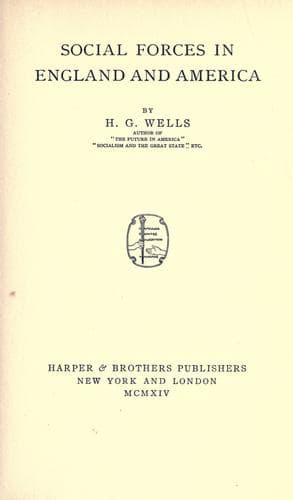
Social Forces in England and AmericaWells, H. G. (Herbert George)
History
Social Forces in England and America
Wells, H. G. (Herbert George)
England -- Social conditions -- 20th century; Social problems; United States -- Social conditions -- 1865-1918
And in the third place it is to be remarked that the American tradition
has defeated its dearest aims of a universal freedom and a practical
equality. The economic process of the last half-century, so far as
America is concerned, has completely justified the generalisations of
Marx. There has been a steady concentration of wealth and of the reality
as distinguished from the forms of power in the hands of a small
energetic minority, and a steady approximation of the condition of the
mass of the citizens to that of the so-called proletariat of the
European communities. The tradition of individual freedom and equality
is, in fact, in process of destroying the realities of freedom and
equality out of which it rose. Instead of the six hundred thousand
families of the year 1790, all at about the same level of property and,
excepting the peculiar condition of seven hundred thousand blacks, with
scarcely anyone in the position of a hireling, we have now as the most
striking, though by no means the most important, fact in American social
life a frothy confusion of millionaires’ families, just as wasteful,
foolish and vicious as irresponsible human beings with unlimited
resources have always shown themselves to be. And, concurrently with the
appearance of these concentrations of great wealth, we have appearing
also poverty, poverty of a degree that was quite unknown in the United
States for the first century of their career as an independent nation.
In the last few decades slums as frightful as any in Europe have
appeared with terrible rapidity, and there has been a development of the
viler side of industrialism, of sweating and base employment of the most
ominous kind.
In Mr. Robert Hunter’s _Poverty_ one reads of “not less than eighty
thousand children, most of whom are little girls, at present employed in
the textile mills of this country. In the South there are now six times
as many children at work as there were twenty years ago. Child labour is
increasing yearly in that section of the country. Each year more little
ones are brought in from the fields and hills to live in the degrading
and demoralising atmosphere of the mill towns....”
Children are deliberately imported by the Italians. I gathered from
Commissioner Watchorn at Ellis Island that the proportion of little
nephews and nieces, friends’ sons and so forth brought in by them is
peculiarly high, and I heard him try and condemn a doubtful case. It was
a particularly unattractive Italian in charge of a dull-eyed little boy
of no ascertainable relationship....
Public-domain text, read in full here on John Shaqi.
Reviews
Reviews
No reviews yet
Be the first to share your thoughts on this work.
Elsewhere in the archive
Join the Discussion
Join the discussion
Sign in to leave a comment or review.
Sign InorCreate an account