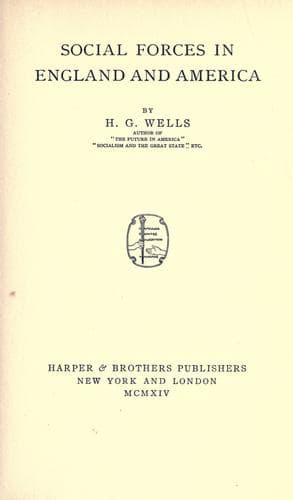
Social Forces in England and AmericaWells, H. G. (Herbert George)
History
Social Forces in England and America
Wells, H. G. (Herbert George)
England -- Social conditions -- 20th century; Social problems; United States -- Social conditions -- 1865-1918
Now, I am disposed to suspect at times that an inkling of such a
realisation may have come to some of these very rich men. I am inclined
to put it among the possibilities of our time that it may presently
become clearly and definitely the inspiring idea of many of those who
find themselves predominantly rich. I do not see why these active rich
should not develop statesmanship, and I can quite imagine them
developing very considerable statesmanship. Because these men were able
to realise their organising power in the absence of economic
organisation, it does not follow that they will be fanatical for a
continuing looseness and freedom of property. The phase of economic
liberty ends itself, as Marx long ago pointed out. The American business
world becomes more and more a managed world with fewer and fewer wild
possibilities of succeeding. Of all people the big millionaires should
realise this most acutely, and, in fact, there are many signs that they
do. It seems to me that the educational zeal of Mr. Andrew Carnegie and
the university and scientific endowments of Mr. Rockefeller are not
merely showy benefactions; they express a definite feeling of the
present need of constructive organisation in the social scheme. The time
has come to build. There is, I think, good reason for expecting that
statesmanship of the millionaires to become more organised and
scientific and comprehensive in the coming years. It is plausible at
least to maintain that the personal quality of the American plutocracy
has risen in the last three decades, has risen from the quality of a
mere irresponsible wealthy person towards that of a real aristocrat with
a “sense of the State.” That one may reckon the first hopeful
possibility in the American outlook.
And intimately connected with this development of an attitude of public
responsibility in the very rich is the decay on the one hand of the
preposterous idea once prevalent in America that politics is an
unsuitable interest for a “gentleman,” and on the other of the
democratic jealousy of any but poor politicians. In New York they talk
very much of “gentlemen,” and by “gentlemen” they seem to mean a rich
man “in society” with a college education. Nowadays, “gentlemen” seem
more and more disposed towards politics, and less and less towards a
life of business or detached refinement. President Roosevelt, for
example, was one of the pioneers in this new development, this
restoration of virility to the gentlemanly ideal. His career marks the
appearance of a new and better type of man in American politics, the
close of the rule of the idealised nobody.
Public-domain text, read in full here on John Shaqi.
Reviews
Reviews
No reviews yet
Be the first to share your thoughts on this work.
Elsewhere in the archive
Join the Discussion
Join the discussion
Sign in to leave a comment or review.
Sign InorCreate an account