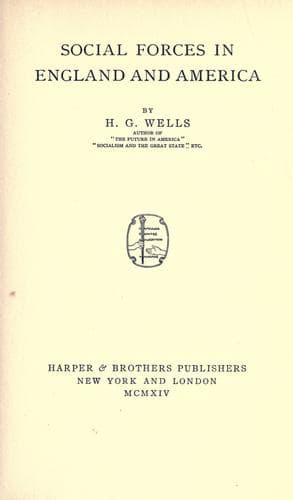
Social Forces in England and AmericaWells, H. G. (Herbert George)
History
Social Forces in England and America
Wells, H. G. (Herbert George)
England -- Social conditions -- 20th century; Social problems; United States -- Social conditions -- 1865-1918
It is interesting to point the direction in which this desire for
independence will probably take them. They will discover that the
dependence of women at the present time is not so much a law-made as an
economic dependence due to the economic disadvantages their sex imposes
upon them. Maternity and the concomitants of maternity are the
circumstances in their lives, exhausting energy and earning nothing,
that place them at a discount. From the stage when property ceased to be
chiefly the creation of feminine agricultural toil (the so-called
primitive matriarchate) to our present stage, women have had to depend
upon a man’s willingness to keep them, in order to realise the organic
purpose of their being. Whether conventionally equal or not, whether
voters or not, that necessity for dependence will still remain under our
system of private property and free independent competition. There is
only one evident way by which women as a class can escape from that
dependence each upon an individual man and from all the practical
inferiority this dependence entails, and that is by so altering their
status as to make maternity and the upbringing of children a charge not
upon the husband or the mother but upon the community. The public
Endowment of Maternity is the only route by which the mass of women can
reach that personal freedom and independent citizenship so many of them
desire.
Now, this idea of the Endowment of Maternity—or, as it is frequently
phrased, the Endowment of the Home—is at present put forward by the
modern Socialists as an integral part of their proposals, and it is
interesting to note that there is this convergent possibility which may
bring the feminist movement at last altogether into line with
constructive Socialism. Obviously, before anything in the direction of
family endowment becomes practicable, public bodies and the State
organisation will need to display far more integrity and efficiency than
they do in America at the present time. Still, that is the trend of
things in all contemporary civilised communities, and it is a trend that
will find a powerful reinforcement in men’s solicitudes as the
increasing failure of the unsupported private family to produce
offspring adequate to the needs of social development becomes more and
more conspicuous. The impassioned appeals of President Roosevelt have
already brought home the race-suicide of the native-born to every
American intelligence, but mere rhetoric will not in itself suffice to
make people, insecurely employed and struggling to maintain a
comfortable standard of life against great economic pressure, prolific.
Presented as a call to a particularly onerous and quite unpaid social
duty the appeal for unrestricted parentage fails. Husband and wife alike
dread an excessive burthen. Travel, leisure, freedom, comfort, property
and increased ability for business competition are the rewards of
abstinence from parentage, and even the disapproval of President
Public-domain text, read in full here on John Shaqi.
Reviews
Reviews
No reviews yet
Be the first to share your thoughts on this work.
Elsewhere in the archive
Join the Discussion
Join the discussion
Sign in to leave a comment or review.
Sign InorCreate an account