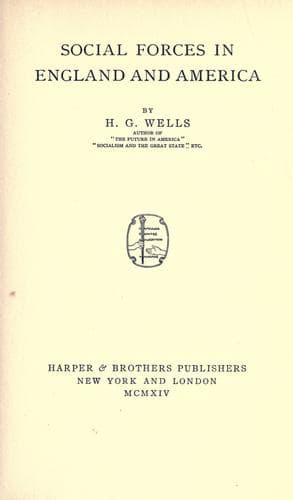
Social Forces in England and AmericaWells, H. G. (Herbert George)
History
Social Forces in England and America
Wells, H. G. (Herbert George)
England -- Social conditions -- 20th century; Social problems; United States -- Social conditions -- 1865-1918
Metchnikoff has speculated upon the possibility of delaying old age, and
I do not see why his method should not be applied to the diurnal need of
sleep. No vital process seems to be absolutely fated in itself; it is a
thing conditioned and capable of modification. If Metchnikoff is
right—and to a certain extent he must be right—the decay of age is due
to changing organic processes that may be checked and delayed and
modified by suitable food and regimen. He holds out hope of a new phase
in the human cycle, after the phase of struggle and passion, a phase of
serene intellectual activity, old age with all its experience and none
of its infirmities. Still more are fatigue and the need for repose
dependent upon chemical changes in the body. It would seem we are unable
to maintain exertion, partly through the exhaustion of our tissues, but
far more by the loading of our blood with fatigue products—a
recuperative interlude must ensue. But there is no reason to suppose
that the usual food of to-day is the most rapidly assimilable nurture
possible, that a rapidly digestible or injectable substance is not
conceivable that would vastly accelerate repair, nor that the
elimination and neutralisation of fatigue products might not also be
enormously hastened. There is no inherent impossibility in the idea not
only of various glands being induced to function in a modified manner,
but even in the insertion upon the circulation of interceptors and
artificial glandular structures. No doubt that may strike even an
adventurous surgeon as chimerical, but consider what people, even
authoritative people, were saying of flying and electric traction twenty
years ago. At present a man probably does not get more than three or
four hours of maximum mental and physical efficiency in the day. Few men
can keep at their best in either physical or intellectual work for so
long as that. The rest of the time goes in feeding, digesting, sleeping,
sitting about, relaxation of various kinds. It is quite possible that
science may set itself presently to extend systematically that
proportion of efficient time. The area of maximum efficiency may invade
the periods now demanded by digestion, sleep, exercise, so that at last
nearly the whole of a man’s twenty-four hours will be concentrated on
his primary interests instead of dispersed among these secondary
necessary matters.
Public-domain text, read in full here on John Shaqi.
Reviews
Reviews
No reviews yet
Be the first to share your thoughts on this work.
Elsewhere in the archive
Join the Discussion
Join the discussion
Sign in to leave a comment or review.
Sign InorCreate an account