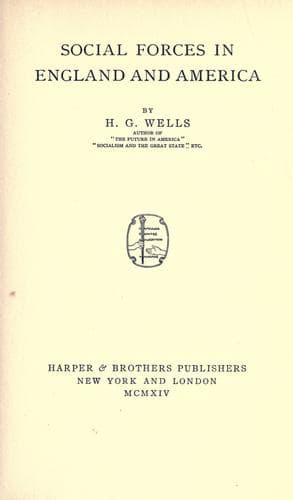
Social Forces in England and AmericaWells, H. G. (Herbert George)
History
Social Forces in England and America
Wells, H. G. (Herbert George)
England -- Social conditions -- 20th century; Social problems; United States -- Social conditions -- 1865-1918
It would be presumptuous to anticipate the National Plan that must
emerge from so vast a debate, but certain conclusions I feel in my bones
will stand the test of an exhaustive criticism. The first is that a
distinction will be drawn between what I would call “interesting work”
and what I would call “mere labour.” The two things, I admit, pass by
insensible gradations into one another, but while on one hand such work
as being a master gardener and growing roses, or a master cabinet maker
and making fine pieces, or an artist of almost any sort, or a story
writer, or a consulting physician, or a scientific investigator, or a
keeper of wild animals, or a forester, or a librarian, or a good
printer, or many sorts of engineer, is work that will always find men of
a certain temperament enthusiastically glad to do it, if they can only
do it for comfortable pay—for such work is in itself _living_—there is,
on the other hand, work so irksome and toilsome, such as coal mining, or
being a private soldier during a peace, or attending upon lunatics, or
stoking, or doing over and over again, almost mechanically, little bits
of a modern industrial process, or being a cash desk clerk in a busy
shop, that few people would undertake if they could avoid it.
And the whole strength of our collective intelligence will be directed
first to reducing the amount of such irksome work by labour-saving
machinery, by ingenuity of management, and by the systematic avoidance
of giving trouble as a duty, and then to so distributing the residuum of
it that it will become the whole life of no class whatever in our
population. I have already quoted the idea of Professor William James of
a universal conscription for such irksome labour, and while he would
have instituted that mainly for its immense moral effect upon the
community, I would point out that, combined with a nationalisation of
transport, mining, and so forth, it is also a way to a partial solution
of this difficulty of “mere toil.”
Public-domain text, read in full here on John Shaqi.
Reviews
Reviews
No reviews yet
Be the first to share your thoughts on this work.
Elsewhere in the archive
Join the Discussion
Join the discussion
Sign in to leave a comment or review.
Sign InorCreate an account