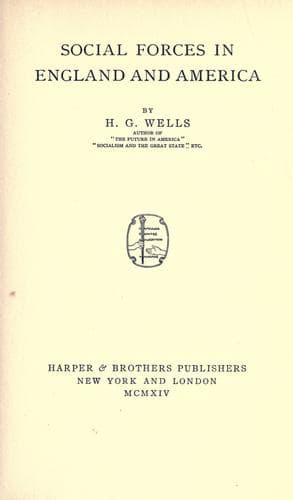
Social Forces in England and AmericaWells, H. G. (Herbert George)
History
Social Forces in England and America
Wells, H. G. (Herbert George)
England -- Social conditions -- 20th century; Social problems; United States -- Social conditions -- 1865-1918
These are people who really do consider the Normal Social Life as the
only proper and desirable life for the great mass of humanity, and they
are fully prepared to subordinate all exceptional and surplus lives to
the moral standards and limitations that arise naturally out of the
Normal Social Life. They desire a state in which property is widely
distributed, a community of independent families protected by law and an
intelligent democratic statecraft from the economic aggressions of large
accumulations and linked by a common religion. Their attitude to the
forces of change is necessarily a hostile attitude. They are disposed to
regard innovations in transit and machinery as undesirable, and even
mischievous disturbances of a wholesome equilibrium. They are at least
unfriendly to any organisation of scientific research, and scornful of
the pretensions of science. Criticisms of the methods of logic,
scepticism of the more widely diffused human beliefs, they would
classify as insanity. Two able English writers, Mr. G. K. Chesterton and
Mr. Belloc, have given the clearest expression to this system of ideals,
and stated an admirable case for it. They present a conception of
vinous, loudly singing, earthy, toiling, custom-ruled, wholesome, and
insanitary men; they are pagan in the sense that their hearts are with
the villagers and not with the townsmen, Christian in the spirit of the
parish priest. There are no other Conservators so clear-headed and
consistent. But their teaching is merely the logical expression of an
enormous amount of conservative feeling. Vast multitudes of less lucid
minds share their hostility to novelty and research; hate, dread, and
are eager to despise science, and glow responsive to the warm, familiar
expressions of primordial feelings and immemorial prejudices. The rural
conservative, the liberal of the allotments and small-holdings type, Mr.
Roosevelt—in his Western-farmer, philoprogenitive phase as distinguished
from the phase of his more imperialist moments—all present themselves as
essentially Conservators, as seekers after and preservers of the Normal
Social Life.
Public-domain text, read in full here on John Shaqi.
Reviews
Reviews
No reviews yet
Be the first to share your thoughts on this work.
Elsewhere in the archive
Join the Discussion
Join the discussion
Sign in to leave a comment or review.
Sign InorCreate an account