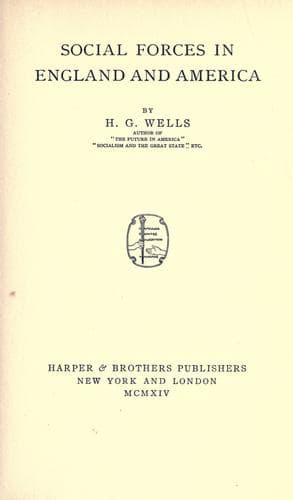
Social Forces in England and AmericaWells, H. G. (Herbert George)
History
Social Forces in England and America
Wells, H. G. (Herbert George)
England -- Social conditions -- 20th century; Social problems; United States -- Social conditions -- 1865-1918
Let me briefly recapitulate the main problems which have to be attacked
in the attempt to realise the outline of the Great State. At the base of
the whole order there must be some method of agricultural production,
and if the agricultural labourer and cottager and the ancient life of
the small householder on the holding, a life laborious, prolific,
illiterate, limited, and in immediate contact with the land used, is to
recede and disappear, it must recede and disappear before methods upon a
much larger scale, employing wholesale machinery and involving great
economies. It is alleged by modern writers that the permanent residence
of the cultivator in close relation to his ground is a legacy from the
days of cumbrous and expensive transit, that the great proportion of
farm work is seasonal, and that a migration to and fro between rural and
urban conditions would be entirely practicable in a largely planned
community. The agricultural population could move out of town into an
open-air life as the spring approached, and return for spending,
pleasure, and education as the days shortened. Already something of this
sort occurs under extremely unfavourable conditions in the movement of
the fruit and hop pickers from the east end of London into Kent, but
that is a mere hint of the extended picnic which a broadly planned
cultivation might afford. A fully developed civilisation employing
machines in the hands of highly skilled men will minimise toil to the
very utmost, no man will shove where a machine can shove, or carry where
a machine can carry; but there will remain, more particularly in the
summer, a vast amount of hand operations, invigorating and even
attractive to the urban population. Given short hours, good pay, and all
the jolly amusement in the evening camp that a free, happy, and
intelligent people will develop for themselves, and there will be little
difficulty about this particular class of work to differentiate it from
any other sort of necessary labour.
One passes, therefore, with no definite transition from the root problem
of agricultural production in the Great State to the wider problem of
labour in general.
A glance at the countryside conjures up a picture of extensive tracts
being cultivated on a wholesale scale, of skilled men directing great
ploughing, sowing, and reaping plants, steering cattle and sheep about
carefully designed enclosures, constructing channels and guiding sewage
towards its proper destination on the fields, and then of added crowds
of genial people coming out to spray trees and plants, pick and sort and
pack fruits. But who are these people? Why are they in particular doing
this for the community? Is our Great State still to have a majority of
people glad to do commonplace work for mediocre wages, and will there be
other individuals who will ride by on the roads, sympathetically, no
doubt, but with a secret sense of superiority? So one opens the general
problem of the organisation for labour.
Public-domain text, read in full here on John Shaqi.
Reviews
Reviews
No reviews yet
Be the first to share your thoughts on this work.
Elsewhere in the archive
Join the Discussion
Join the discussion
Sign in to leave a comment or review.
Sign InorCreate an account