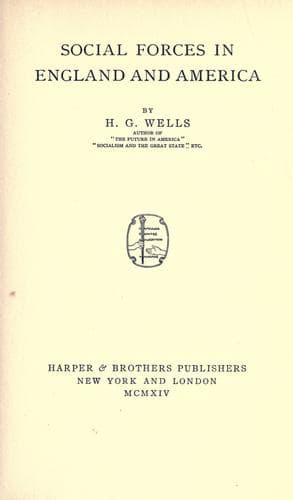
Social Forces in England and AmericaWells, H. G. (Herbert George)
History
Social Forces in England and America
Wells, H. G. (Herbert George)
England -- Social conditions -- 20th century; Social problems; United States -- Social conditions -- 1865-1918
We have, in fact, to invent for the Great State, if we are to suppose
any Great State at all, an economic method without any specific labour
class. If we cannot do so, we had better throw ourselves in with the
Conservators forthwith, for they are right and we are absurd. Adhesion
to the conception of the Great State involves adhesion to the belief
that the amount of regular labour, skilled and unskilled, required to
produce everything necessary for everyone living in its highly elaborate
civilisation may, under modern conditions, with the help of scientific
economy and power-producing machinery, be reduced to so small a number
of working hours per head in proportion to the average life of the
citizen, as to be met as regards the greater moiety of it by the payment
of wages over and above the gratuitous share of each individual in the
general output; and as regards the residue, a residue of rough,
disagreeable, and monotonous operations, by some form of conscription,
which will demand a year or so, let us say, of each person’s life for
the public service. If we reflect that in the contemporary state there
is already food, shelter, and clothing of a sort for everyone, in spite
of the fact that enormous numbers of people do no productive work at all
because they are too well off, that great numbers are out of work, great
numbers by bad nutrition and training incapable of work, and that an
enormous amount of the work actually done is the overlapping production
of competitive trade and work upon such politically necessary but
socially useless things as Dreadnoughts, it becomes clear that the
absolutely unavoidable labour in a modern community and its ratio to the
available vitality must be of very small account indeed. But all this
has still to be worked out even in the most general terms. An
intelligent science of Economics should afford standards and
technicalities and systematised facts upon which to base an estimate.
The point was raised a quarter of a century ago by Morris in his _News
from Nowhere_, and indeed it was already discussed by More in his
_Utopia_. Our contemporary economics is, however, still a foolish,
pretentious pseudo-science, a festering mass of assumptions about buying
and selling and wages-paying, and one would as soon consult Bradshaw or
the works of Dumas as our orthodox professors of Economics for any light
upon this fundamental matter.
Public-domain text, read in full here on John Shaqi.
Reviews
Reviews
No reviews yet
Be the first to share your thoughts on this work.
Elsewhere in the archive
Join the Discussion
Join the discussion
Sign in to leave a comment or review.
Sign InorCreate an account