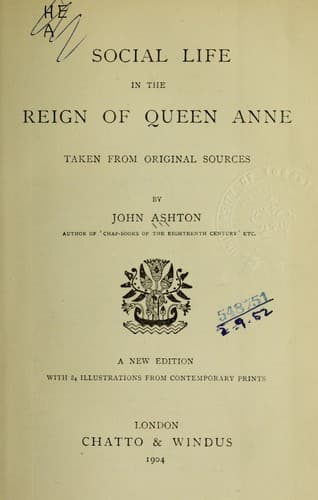
Social Life in the Reign of Queen Anne, Taken from Original SourcesAshton, John
History
Social Life in the Reign of Queen Anne, Taken from Original Sources
Ashton, John
Great Britain -- History -- Anne, 1702-1714; Great Britain -- Social life and customs -- 18th century
Perhaps few people now would care to make Mr. Lamb's '_Patty of
Calves' Brains_.--The Calves Brains being clean, scald them, then
blanch some Asparagus, and put it in a Sauce pan, with a little Butter
and Parsley; being Cold, put the Brains in the Patty, with the
Asparagus, five or six Yolks of hard Eggs, and Forc'd Meat; season it
with Pepper and Salt. When it is bak'd, add the Juce of a Lemon, drawn
Butter and Gravy. _So serve it._'
Listen to Misson's ecstasies over our national dish--the PUDDING. 'The
_Pudding_ is a Dish very difficult to be describ'd, because of the
several Sorts there are of it; Flower, Milk, Eggs, Butter, Sugar,
Suet, Marrow, Raisins, &c., &c., are the most common Ingredients of a
_Pudding_. They bake them in an Oven, they boil them with Meat, they
make them fifty several Ways: BLESSED BE HE THAT INVENTED PUDDING,
for it is a Manna that hits the Palates of all Sorts of People: a
Manna better than that of the Wilderness, because the People are never
weary of it. Ah, what an excellent Thing is an _English Pudding_! _To
come in Pudding time_, is as much as to say, to come in the most lucky
Moment in the World.'[260]
[Footnote 260: There was 'the Royal Peace Pudding, Tickets
1_s._ each, Made on Thanksgiving Day, 1713, 9 feet long,
20-1/2 inches broad, and 6 inches deep,' and there were the
famous 12_d._ Marrow puddings. Blood Puddings were also in
vogue. See _Trivia_:--
'Blood stuff'd in Skins is _British_ Christian Food,
And _France_ robs Marshes of the croaking Brood;
Spongy _Morells_ in strong Ragousts are found,
And in the _Soupe_ the slimy Snail is drown'd.']
[Illustration: 'Four for Sixpence, Mackerell.']
Of fish he says: 'In Proportion Fish is dearer than any other
Belly-timber at London;' and as a matter of fact we hear very little
about it as an article of food. The country, inland, was of course
entirely dependent upon fresh-water fish, such as carp, jack, perch,
etc. The London market was at Billingsgate (which kept up its
reputation for its peculiar vernacular), but that was also waterman's
stairs, and a place of departure for boats; and here was sold whatever
fish was brought to London. A little before every Lent came vessels
loaded with salt cod, which were sold at 1_s._ 6_d._ to 2_s._ a
couple, and sometimes at 1_d._ per lb. Mackerel, on account of its
perishable nature, was allowed to be sold on Sunday, as Gay notes,
'Ev'n Sundays are prophan'd by Mackrell cries.'
From Billingsgate the fish was distributed to the various stalls
throughout London:--
You'll see a draggled Damsel, here and there,
From _Billingsgate_ her fishy Traffick bear.
And these stalls are thus described:--
Public-domain text, read in full here on John Shaqi.
Reviews
Reviews
No reviews yet
Be the first to share your thoughts on this work.
Elsewhere in the archive
Join the Discussion
Join the discussion
Sign in to leave a comment or review.
Sign InorCreate an account