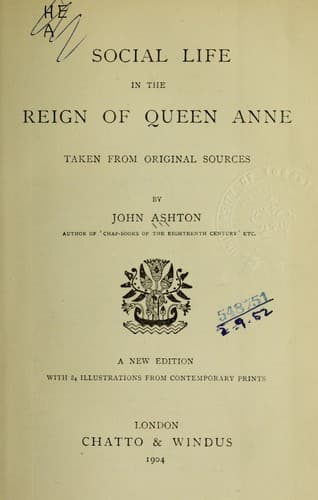
Social Life in the Reign of Queen Anne, Taken from Original SourcesAshton, John
History
Social Life in the Reign of Queen Anne, Taken from Original Sources
Ashton, John
Great Britain -- History -- Anne, 1702-1714; Great Britain -- Social life and customs -- 18th century
[Footnote 321: _Tatler_, 79.]
This tavern was so popular that a rival sprang up on the other side of
the street, the 'Young Devil,' and here, for a year or so, from the
beginning of 1708, till some time in or about 1709, the Society of
Antiquaries held their meetings, afterwards at the 'Fountain' tavern,
Inner Temple Gate. The 'Cock,' in Fleet Street, has only just been
demolished. There was another famous tavern which was near St.
Dunstan's Church, in Fleet Street, called 'The Hercules' Pillars,'
which was visited by Pepys, as appears by four entries in his diary.
Another tavern of this name, at Charing Cross, will be noted when
treating of the amusements of the people. The 'Mitre' tavern must not
be confounded with the coffee-house of that name in Mitre Court, but
was the one frequented by Dr. Johnson, and so often referred to by
Boswell.
The 'Palsgrave's Head,' on the south side of the Strand, near Temple
Bar, was then a coffee-house, and was so named from the Palsgrave
Frederick, afterwards King of Bohemia, who married the Princess
Elizabeth, daughter of James I. The 'Crown and Anchor,' which
stretched along the Strand from Arundel Street to Milford Lane, was
famous as being the place where the Academy of Music was instituted in
1710. The 'Rose' tavern in Drury Lane is frequently mentioned in the
literature of this time. It was afterwards absorbed into Drury Lane
Theatre, when Garrick enlarged it in 1776. The 'Rummer Tavern,' at
Charing Cross, near Locket's Ordinary, is often mentioned in
advertisements, and Brown and Ward speak of 'Heaven' and 'Hell,' which
were two ale-houses near Westminster Hall. Pepys notices one of them
on January 28, 1660--'And so I returned, and went to Heaven, where
Ludlin and I dined.' And last, not least, was the 'Bumper' tavern,
which 'Dick Estcourt,' the actor, opened on January 1, 1712, and
which Steele so kindly puffed in _Spectator_ No. 264. An exhaustive
catalogue of the taverns in the City is given by Ward in his 'Vade
Mecum for Maltworms,' a very curious and now rare book; but it is
hardly worth while to reproduce their names, even in an appendix.
CHAPTER XIX.
CLUBS.
Origin -- October Club -- Calves Head Club -- Kit Cat Club --
Other clubs -- Suggested clubs.
The name of Club is undoubtedly taken from the practice of a jovial
company to 'club,' or divide the whole expenses of the entertainment;
and 'the payment of our Clubs'[322] is a frequently mentioned wind-up
of any festivity. Naturally, such agreeable meetings were repeated
until they became habitual, and the society, or _club_, was formed;
and these humble beginnings laid the foundation of that great social
organisation which nowhere flourishes better than in England.
[Footnote 322: _London Spy._]
Public-domain text, read in full here on John Shaqi.
Reviews
Reviews
No reviews yet
Be the first to share your thoughts on this work.
Elsewhere in the archive
Join the Discussion
Join the discussion
Sign in to leave a comment or review.
Sign InorCreate an account