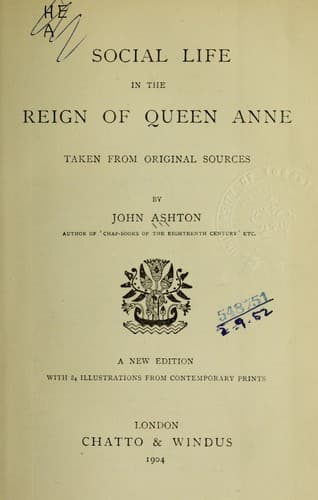
Social Life in the Reign of Queen Anne, Taken from Original SourcesAshton, John
History
Social Life in the Reign of Queen Anne, Taken from Original Sources
Ashton, John
Great Britain -- History -- Anne, 1702-1714; Great Britain -- Social life and customs -- 18th century
If in the Soil you guide the crooked Share,
Your early Breakfast is my Constant Care.
And when with even Hand you strow the Grain,
I fright the thievish Rooks from off the Plain.
In misling Days when I my Threasher heard,
With Nappy Beer I to the Barn repair'd;
Lost in the Musick of the whirling Flail,
To gaze on thee I left the smoaking Pail;
In Harvest, when the Sun was mounted high,
My Leather Bottle did thy Drought supply;
When e'er you mow'd I followed with the Rake,
And have full oft been Sun burnt for thy Sake;
When in the Welkin gath'ring Show'rs were seen,
I lagg'd the last with _Colin_ on the Green;
And when at Eve returning with thy Carr,
Awaiting heard the gingling Bells from far;
Strait on the Fire the sooty Pot I plac't,
To warm thy Broth I burnt my Hands for Haste.
When hungry thou stood'st _staring, like an Oaf_,
I slic'd the Luncheon from the Barly Loaf,
With crumbled Bread I thicken'd well thy Mess,
Ah, love me more, or love thy Pottage less![411]
[Footnote 411: _The Shepherd's Week_--_The Ditty_, ed.
1714.]
The dress of the labourer at this time was a broad-brimmed flap felt
hat, a jerkin, or short coat, knee breeches and stockings; whilst the
women wore their dresses very plainly made--necessarily without
furbelows and hoops, and, for headgear, had a very sensible
broad-brimmed straw hat, or, on holidays, the high-crowned felt hat.
CHAPTER XXV.
THE DRAMA.
The theatres -- Dorset Gardens -- Its demolition -- Performances
-- Lincoln's Inn Fields -- Theatre Royal, Drury Lane -- Its
company -- Mrs. Tofts -- The Queen's Theatre, Haymarket -- Its
foundation stone -- Its operas -- Pinkethman's theatre at
Greenwich -- The Queen and the Stage -- Her reforms -- Strolling
players -- Behaviour at the theatre -- Orange wenches -- Stage
properties -- Actors -- Betterton -- Verbruggen -- Cave Underhill
-- Estcourt -- Dogget -- Colley Cibber -- Wilks -- Booth --
Pinkethman -- Minor actors -- Actresses -- Mrs. Barry -- Mrs.
Bracegirdle -- Mrs. Oldfield -- Mrs. Verbruggen -- The ballet.
The drama was fairly supported in Queen Anne's time, although there
were never more than three theatres open at once, and generally only
two. It was not an age for either striking actors or immortal plays;
but, as to the former, they were hard-working, and some of them have
left a name behind them renowned in the history of the stage; and, for
the latter, they were, although somewhat coarse in humour, not so
licentious as the plays of the three preceding reigns. It is
impossible, within the limits of this book, to do more than generalise
on the drama of that day--its history has materials in it for a book
to itself.
There were four theatres: Dorset Gardens, Lincoln's Inn Fields, Drury
Lane, and the Queen's Theatre, Haymarket.
Public-domain text, read in full here on John Shaqi.
Reviews
Reviews
No reviews yet
Be the first to share your thoughts on this work.
Elsewhere in the archive
Join the Discussion
Join the discussion
Sign in to leave a comment or review.
Sign InorCreate an account