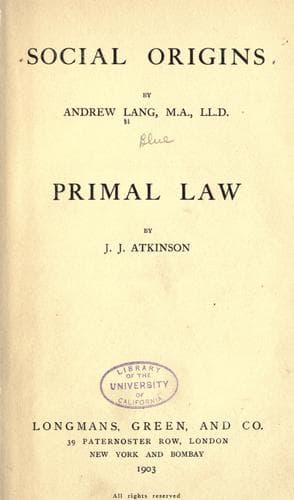
Amongst marriage customs that which has given rise to most discussion
as regards its origin is ‘Exogamy’ or marriage outside the family
group, or outside the limit of the totem name. My general argument, as
will be seen, places me in antagonism with all theories yet advanced
on the subject. But Mr. Lang, in _Custom and Myth_, 1884 (p. 258),
hazards, as his own impression, a conception of this matter which I
will note--namely, that ‘Exogamy, may be connected with some early
idea of which we have lost touch,’ and he adds, ‘If we only knew the
origin of the prohibition to marry within the _family_[3] all would be
plain sailing.’ However utterly beyond human ken, in these our latter
days, any truthful image of so remote a past may seem to be, it is
yet precisely this hypothetic early idea which I hope to be able to
expose. (If I am correct, we shall find that it was connected with
the sexual relations of primitive man, _whilst in the animal stage_,
and especially with the mutual marital rights of the males within
a group.) Such idea in travail, hastened and sharpened by needs of
environment, created issues which necessarily gave birth to a ‘Primal
Law’ prohibitory of marriage between certain members of a family or
local group, and thus, in natural sequence, led to _forced_ connubial
union _beyond_ its circle the family, or local group--that is, led to
Exogamy. But if such was in reality the original order of succession
in the growth of custom, it becomes evident that Exogamy as a _habit_
(not as an expressed law) must have been of primordial evolution.
Thus (in contra-distinction to generally received opinion and to
Mr. McLennan’s theory in particular) Exogamy must have been a cause
rather than an effect in relation to its ordinary concomitants, i.e.
Female Infanticide as a custom, Polyandry as a fixed institution, and
Totemism as connected with exogamous groups, within which marriage was
forbidden. As thus my new hypothesis finds itself in opposition to
those of recognised authorities, it is evident that it will require to
account for all the facts if it is to hold its ground.
However convinced the author may be by the array of seemingly
confirmatory details in favour of his hypothesis, it is possible that
from their paucity they may yet to others seem to constitute but a
feeble line of defensive proof. But if the theory shall prove in itself
to have merit, this defect (arising, as I believe, from lack of general
anthropological knowledge on my part, for I dwell ‘far from books’)
will quickly be remedied, for a hundred other details in favour of my
view will be at once perceived by more experienced students. Should my
hypothesis really furnish the clue to the problem of the prohibition
to marry within the family name, or totem name, all the rest will
doubtless become ‘plain sailing’ in competent hands.
Public-domain text, read in full here on John Shaqi.
Reviews
Reviews
No reviews yet
Be the first to share your thoughts on this work.
Elsewhere in the archive
Join the Discussion
Join the discussion
Sign in to leave a comment or review.
Sign InorCreate an account