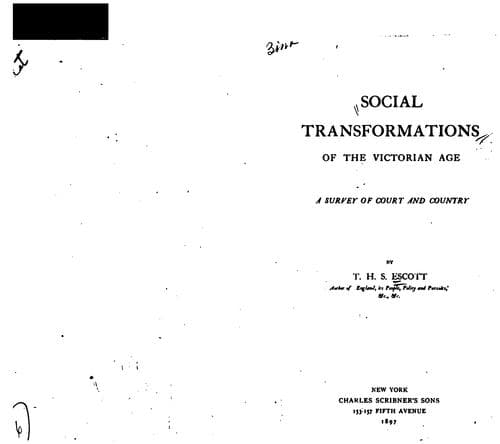
Social Transformations of the Victorian Age: A Survey of Court and CountryEscott, T. H. S. (Thomas Hay Sweet)
History
Social Transformations of the Victorian Age: A Survey of Court and Country
Escott, T. H. S. (Thomas Hay Sweet)
Great Britain -- Civilization -- 19th century; Great Britain -- Social life and customs -- 19th century
Of the many transformations wrought by Victorian science, not the
least;--unscientific people might think it the greatest--is the
assimilation of the idiom of fiction to that of the text books of the
schools. The entire ethos of our oral diction not less than our
literature has been revolutionized by science. When a parliamentary
speaker illustrates his argument by a metaphor, it is not, as his
forerunners once did, to the Latin and Greek classics, or even to
literature at all, but to the laboratory, to the dissecting room, or to
the crucible that he most frequently goes for his _trope_. The similes of
the Attic masterpieces are taken habitually from those operations with
which their naval empire familiarized the Athenian mind. Nor can these
metaphors be understood without some remembrance of the processes which
marine affairs involve. A similar acquaintance with the later operations
of science is scarcely less useful for a proper appreciation of the most
characteristic beauties of Victorian prose, by whatever master displayed.
This dispossession of the literary by the scientific is universal.
Following unconsciously perhaps the example of a great statesman, those
who have in our day most widely differed from him on national affairs, a
Randolph Churchill, or a Charles Stewart Parnell have reproduced the taste
of a Salisbury in finding their recreations, not in the _belles lettres_
that were congenial to the day of a Pitt or a Canning, but in the
researches that a Tyndall, a Huxley, a Thomson, have popularized.
Galileo's astronomical views found a useful ally by the incisive raillery
of his literary style. The admirable prose of a Huxley and his fellow
labourers has been no less effective for popularizing scientific studies
with the public they have addressed. The social urbanity with which
Nature and training have endowed Sir John Lubbock has prepossessed not a
few on his own level in life in favour of those branches of physical
enquiry that have enabled him to rehabilitate the moral character of the
autumnal wasp.
CHAPTER XXIV
CECILIA'S TRIUMPHS
The revolution in the conditions of English music--effected since its
first encouragement by the Victorian Court--illustrated by a contrast
between the social status of the musician to-day, and forty years ago.
Music always a tradition of the present dynasty. Handel. English
machinery for teaching music instituted under the Georgian era, and
perfected under the Victorian. Has English organization for musical
teaching outstripped English capacity for learning? Certain reforms
approved by high musical experts. Other individual agencies than those
of the Court favourable to Music during this century. Mendelssohn; his
encouragement of John Parry, the forerunner of Corney Grain, and
Arthur Cecil. Sir Charles Hallé, Herr Joachim, Grove, Sullivan.
Anglo-German ladies. Crystal Palace Concerts.
Public-domain text, read in full here on John Shaqi.
Reviews
Reviews
No reviews yet
Be the first to share your thoughts on this work.
Elsewhere in the archive
Join the Discussion
Join the discussion
Sign in to leave a comment or review.
Sign InorCreate an account