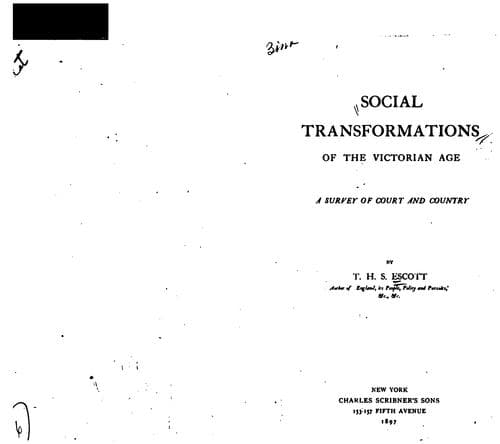
Social Transformations of the Victorian Age: A Survey of Court and CountryEscott, T. H. S. (Thomas Hay Sweet)
History
Social Transformations of the Victorian Age: A Survey of Court and Country
Escott, T. H. S. (Thomas Hay Sweet)
Great Britain -- Civilization -- 19th century; Great Britain -- Social life and customs -- 19th century
To-day the lady who condescends to teach the art of pianoforte execution
to the young people in a popular London quarter drives up to the house in
her own victoria and would no more be kept waiting a minute for her
appointment than if she were a duchess in her own right. The accomplished
foreigner who plays the violin alights from a brougham drawn by a pair of
thoroughbreds. If he is to be induced to honour a friend in Grosvenor
Square with his company at dinner, the invitation must be given at least
three weeks beforehand. The 'master' must choose his own fellow guests,
and supervise the menu before it is finally decided on; the dinner itself
must be so arranged that to a moment it will occupy the time which the
great man prescribes. The conversation must be so contrived as to
coruscate with epigram, and to fascinate with anecdotes all warranted to
be new, lest the diner of the evening should have the slightest touch of
boredom. If these conditions are not satisfied, this arbiter of taste may
refuse to sit through the meal. He is the chartered libertine of the
dining rooms and drawing rooms of the great.
England has always possessed a considerable school of national composers.
These might have achieved the highest triumphs of genius without acquiring
a fraction of that social ascendancy for their art which it has gradually
won. Under the auspices of the Prince Consort first, the patronage of the
Court was secured for the art of St Cecilia. That day already mentioned on
which Lady Lyttelton first heard the Queen's husband playing on the organ
at Windsor was an eventful one for the social esteem of music in the
adopted country of the Royal executant. After this came the Prince's
directorship of the Ancient Concerts, and the arrangement of its
programmes on special occasions by himself. The club principle during the
married life of the Queen had in its popular illustration not gone beyond
infancy. Otherwise, one of the Royal Family would, as he has since done,
regularly have handled the conductor's baton; while for the special
amusement of another a series of smoking concerts might as to-day have
been arranged in Piccadilly palaces.
Public-domain text, read in full here on John Shaqi.
Reviews
Reviews
No reviews yet
Be the first to share your thoughts on this work.
Elsewhere in the archive
Join the Discussion
Join the discussion
Sign in to leave a comment or review.
Sign InorCreate an account