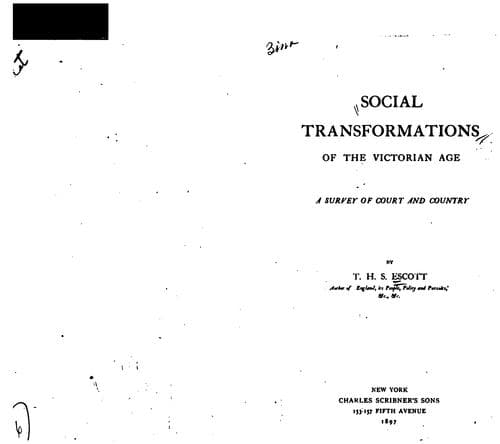
Social Transformations of the Victorian Age: A Survey of Court and CountryEscott, T. H. S. (Thomas Hay Sweet)
History
Social Transformations of the Victorian Age: A Survey of Court and Country
Escott, T. H. S. (Thomas Hay Sweet)
Great Britain -- Civilization -- 19th century; Great Britain -- Social life and customs -- 19th century
The mutual relations of art and wealth are probably for the most part
beneficial to each. The painter, during the latter half of the whole
Victorian age, has been the chief educator of the plutocrat, as Dante
Gabriel Rossetti shrewdly anticipated must prove the case. If the
intellectual teaching of the brush were not easily apprehended, there
would, for the representatives of the new wealth, have been no special
training in the humanities at all. As it is, the aristocracy of wealth,
following the creditable example of the aristocracy of birth, in England
as well as Italy, has secured for itself mental culture not less than
social distinction by its patronage of the creators of the nation's art.
To that rôle it brings the shrewdness already displayed in making its
fortune. Such a patron may be a generous paymaster; he insists on having
value for his money; he is quick to detect scamped work, or shortcomings
in technical detail; he no longer, as he was once fabled to do, buys his
canvases at so much per square foot any more than he fills his library
shelves by the yard. That no meritorious artist in Victorian England is
now likely to live and die so miserably as Haydon is due to the fact that
the newest wealth finds its natural outlet in the encouragement of the
oldest art. No aggregate of spiritual or intellectual interests has ever
been firmly established in England without being subject to some great
organic movement as a test of vitality before its roots struck deep in the
soil of British minds. Literature experienced many such phases. So did
science. So also, in the Oxford Anglican movement and in others since
then, did religion. Before, therefore, the new art was firmly enthroned in
our midst, it was at once shaken and quickened by that nineteenth century
revolution known as pre-Raphaelite; about this so much has been written by
recent experts as to absolve one from the duty of dwelling on it in detail
here. Art in the hands of Rossetti, Burne-Jones, Holman Hunt, and other
men of genius entered upon this ordeal as a sectional and limited pursuit.
It came forth a new national interest or rather one of European concern as
well. Without that severe process of discipline, Leighton and Millais, to
mention only two typical names, would not have taken their place as
masters of the brush for a continental as well as for an insular public.
Nor would the fame of the English school first known through the Paris
Exhibition of 1855, extended by the Paris Exhibition of 1868, have secured
for English artists representation in all the great galleries of the
world, and have added to British painters or to their national themes the
crown of foreign recognition and of cosmopolitan esteem. Later chroniclers
of the Victorian age may be able to record the same progress in the
sculptor's, as in the painter's art. Our climate is not favourable to the
out of door triumphs of the plastic art. But those who have examined the
Public-domain text, read in full here on John Shaqi.
Reviews
Reviews
No reviews yet
Be the first to share your thoughts on this work.
Elsewhere in the archive
Join the Discussion
Join the discussion
Sign in to leave a comment or review.
Sign InorCreate an account