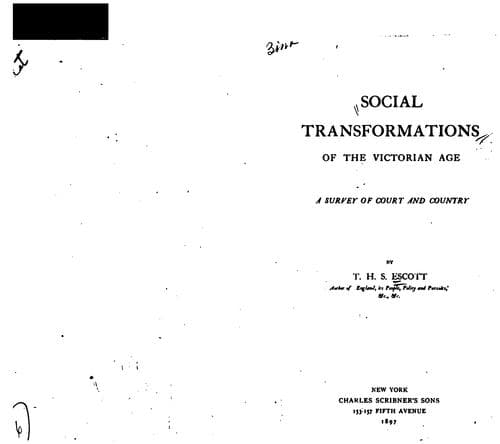
Social Transformations of the Victorian Age: A Survey of Court and CountryEscott, T. H. S. (Thomas Hay Sweet)
History
Social Transformations of the Victorian Age: A Survey of Court and Country
Escott, T. H. S. (Thomas Hay Sweet)
Great Britain -- Civilization -- 19th century; Great Britain -- Social life and customs -- 19th century
GUILDHALL School of Music, founded in 1880, 341;
3496 pupils at, at Christmas 1896, 341.
H
HALLÉ, Charles, born in Westphalia, 1819, 345;
Beethoven's music popularized in England by, 346.
HAMLEY, Sir Edward, sketch of, 308;
his work on the _Operations of War_, 309.
HANDEL, genius of, 344;
recognized by George I. when Elector of Hanover, 344;
his _Te Deum_ performed at St Paul's in Queen Anne's reign, 344;
_Messiah_ produced at Dublin in 1741, 344.
HELPLESS, the, legislative help for, distinctive of Victorian era, 388;
initiated by Prince Consort, 388.
HENRY VIII., privileges of people as enjoyed under Plantagenets,
contracted under, 93;
and under Elizabeth, 93;
practically ceased to exist under the Stuarts, 93.
HENTY, joint-founder of Melbourne, alive 1882, 25.
HERCOMER, Professor, receives pupils into his studio, 353.
HIGHER Grade Elementary Schools, in effect secondary schools, 148;
sixty, under control of English School Boards, 149;
thirty-nine of the, organized as science schools, 149;
4606 boys and 2023 girls, students at, 149.
HIGHER Grade Schools Examination Board, 147.
HOSPITALS, Prince of Wales's fund for relief of, from debt, 390;
transformation in, during Victorian era, 391;
in character of medical students at, 392;
in management and organization of, 392;
revenues of, modern and ancient compared, 392;
St Bartholomew's in 1650 and in 1890, 392;
special and general, 392;
number of, in London, 392;
game, flowers and other presents for, the fashion and rule, 393.
HOUNDS, packs of, number of, in England in 1837, 413;
number of, in England in 1897, 413;
subscribers to and supporters of, in 1897, 414.
HOUSE of Lords, debates such as formerly took place in House of Commons
now confined almost exclusively to, 258;
composition of, similar to composition of old House of Commons, 258;
really a representative body, 264;
socially indistinguishable from Commoners in many ways, 265;
Peers in, created for political and social distinction, 266;
Peerages in, conferred on Lord Carrington, Macaulay, and Tennyson, 265;
later on, on Lord Armstrong, on widow of W. H. Smith and on Lord
Glenesk, 265.
HUDSON, George, the railway king, 6;
his gorgeous chariot, 6;
his personal appearance, 6;
his house at Albert Gate, 6;
entertains royalty, 7;
his fall, 7, 30;
hotel life at Calais, 7;
compared with Beau Brummell, 7;
born at York, son of a linen draper, 15;
drives train conveying Queen and Prince Consort to Cambridge, 29;
member for Sunderland, 30.
HUXLEY, Professor, and spontaneous generation, 330;
his observations anticipated by Schwann, 330.
Public-domain text, read in full here on John Shaqi.
Reviews
Reviews
No reviews yet
Be the first to share your thoughts on this work.
Elsewhere in the archive
Join the Discussion
Join the discussion
Sign in to leave a comment or review.
Sign InorCreate an account