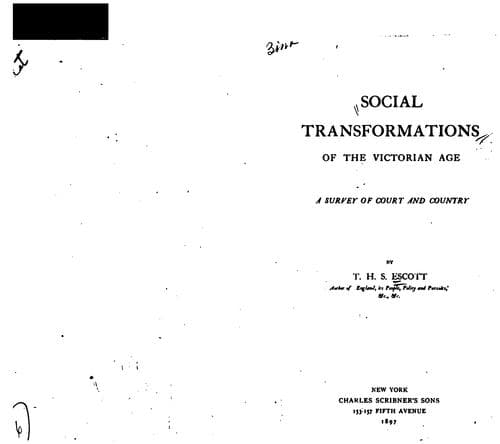
Social Transformations of the Victorian Age: A Survey of Court and CountryEscott, T. H. S. (Thomas Hay Sweet)
History
Social Transformations of the Victorian Age: A Survey of Court and Country
Escott, T. H. S. (Thomas Hay Sweet)
Great Britain -- Civilization -- 19th century; Great Britain -- Social life and customs -- 19th century
SOCIETY, still a close corporation, 198;
but more and more subject to external influences, 198;
recruited from alien elements, 199;
ideal standard of, unaltered, 202.
SOCIETY of comparative legislation, 427.
SOMERSET, Duchess of, the Queen of Beauty at Eglinton tournament, 3.
SOUTH America, English loans to Republics of, 16.
SOUTH Kensington, the whole of, market gardens in 1840, 41;
contrast between the, of 1840 and that of 1890, 321;
labours of Prince Consort in connection with, 322;
entirely the growth of the Victorian era, 354;
an artistic 'Mecca,' 354;
Department of Practical Art at, 356;
under control of Board of Trade, 356;
Department of Science and Art at, 356;
under control of President of the Council, 356;
Marlborough House Collection, removed to, in 1856, 356;
Forster bequest of Dickens's manuscripts to, 357;
institutions affiliated to, 357;
30,000 pupils annually pass through the Science and Art Department at,
357.
SOVEREIGN, constitutional influence of, 261;
increased since days of absolute monarchy, 261;
surrender of political initiative by, 261;
compensated by increase of social ascendancy of, 261;
technical right of, to nominate and dismiss ministers, 261;
exercise of that prerogative in 1834 by William IV., 262;
the permanent head of a department of the State, 262;
view of Prince Consort, as to Sovereign's position, 262;
self-effacement of, impossible under Parliamentary Governments, 264;
the sole guarantee for continuity of policy, 271;
duty of Sovereign to judge which party in state can best carry on the
government of the country, 271.
STEAM, transformation of country by, 27.
STEPHENSON, George, his invention at first decried, 28;
sums up relations between the railways and the country, 37.
SULLIVAN, Sir Arthur, his work and public services, 347.
SUNDAY Schools, started by Robert Raikes late in eighteenth century, 133.
SURGEONS, work of eminent, 395;
exemplified by Cæsar Hawkins, Benjamin Brodie and Spencer Wells, 395.
T
TAIT, Archbishop and family, riders in Hyde Park, 9.
TEACHERS, profession of, no proper representation of, 163;
assistant, in secondary schools, underpaid, 164.
TECHNICAL Education Act, 1890, for teaching handicrafts, 160;
grants authorised to be made by, 100.
TERRY, the family, a family of actors and actresses, 216;
Kate (Mrs Arthur Lewis), peerless in melodrama, 215;
Ellen, as a comedian, 216.
THACKERAY, W. M., distinguished figure in Hyde Park, 6.
THAMES, shocking condition of, between 1804 and 1866, 40.
Public-domain text, read in full here on John Shaqi.
Reviews
Reviews
No reviews yet
Be the first to share your thoughts on this work.
Elsewhere in the archive
Join the Discussion
Join the discussion
Sign in to leave a comment or review.
Sign InorCreate an account