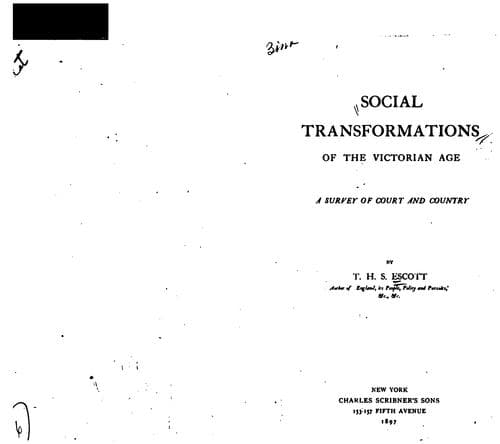
Social Transformations of the Victorian Age: A Survey of Court and CountryEscott, T. H. S. (Thomas Hay Sweet)
History
Social Transformations of the Victorian Age: A Survey of Court and Country
Escott, T. H. S. (Thomas Hay Sweet)
Great Britain -- Civilization -- 19th century; Great Britain -- Social life and customs -- 19th century
[6] Still more than this was given to get men on the home voyage from
Melbourne.
[7] See _Our Railways_. By John Pendleton. Cassell & Co.
[8] Brought down to 1897 instead of 1881, these _mutatis mutandis_ figures
are derived from Mr Mallock's most useful book.
[9] In the West of England, with which the writer is specially acquainted,
this is generally the case.
[10] These figures are taken from 'Art Sales,' by George Redford,
privately printed, 1882.
[11] Now Sir William Agnew.
[12] All the details of art prices given in this chapter are derived from
Mr G. Redford's authentic record of art sales, first privately printed in
1888. For other information the writer is indebted to the late Sir J. E.
Millais, P.R.A.
[13] See Picciotto's Anglo-Jewish History for all these early facts about
the Jews.
[14] The idea of the Exhibition being 'universal' was not that of the
Prince, but of the Committee of the Society of Arts. It was first
suggested in fact by Mr Thomas Winkworth.
[15] Most of the time he was at Ghent. His stay there is known in French
history as _La cour de Gand_.
[16] These anecdotes are given from Mr Reeves' volume already mentioned.
They are suggestive of incident if not uniformly accurate in fact. The
correction of the Waterloo incident given above commended itself to some
among Baron Lionel's friends who would be likely to know.
[17] While Lord Palmerston has become a historical name, Lord
Beaconsfield's precedents are daily, alike by friends and foes, cited as
living forces.
[18] See _Quarterly Review_, July, 1896.
[19] This anecdote was often told by Lord Shaftesbury.
[20] Not, however, the most appreciated by his master.
[21] Now of course Battersea Park.
[22] Who, to the regret of all who knew his abilities, died February 1897,
having exercised influence rather than achieved distinction.
[23] While he yet lives, his enduring monuments are his blocks of working
men's dwellings in the King's Cross district and elsewhere.
[24] The guarantees against undue delegation are stringent and successful.
[25] Opinions vary as to the workability of this clause in the shape in
which it left the Lords.
[26] _E.g._ In a typical Surrey village, where there are no
Nonconformists, the Chairman is the Vicar, but of 38 Gloucestershire
parishes, where dissenters abound, only in two or three.
[27] Urban District Councils have taken the place of Local Boards; they
are in fact town councils of those districts which are not incorporated
into municipalities.
[28] Molesworth's _History of England_, vol. i. p. 19.
[29] As a fact, the County chairman is most likely a J.P. already.
[30] For valuable facts and figures, bringing this chapter down to the
latest date the writer is indebted to Mr Henry Chaplin and his staff at
the Local Government Board, as for much other useful help to Sir Henry
Fowler, Sir Charles Dilke, the Rev. Charles Cox, D.D., and to Mr G. W. E.
Russell.
Public-domain text, read in full here on John Shaqi.
Reviews
Reviews
No reviews yet
Be the first to share your thoughts on this work.
Elsewhere in the archive
Join the Discussion
Join the discussion
Sign in to leave a comment or review.
Sign InorCreate an account